Monday, October 24, 2005
If you think you've got problems...
...consider the case of Mamusu Thoronka, a mother in Sierra Leone trying to look after six children with half a hand.


Doctrine not changed since the 1840s
"The [US] has never taken counterinsurgency seriously. The Army's doctrine hasn't changed since the 1840's." - John Waghelstein, a retired colonel in the Special Forces who helped to conduct the American-backed counterinsurgency campaign in El Salvador, quoted in The Fall of the Warrior King.
One of the most telling lines from Lt. Col. Nathan Sassaman, the star soldier and quarterback, is "Don't they have those people [who do nation-building] at the State Department?"
Well, yes, exactly.
(see also Leadership Failure, from Human Rights Watch)
One of the most telling lines from Lt. Col. Nathan Sassaman, the star soldier and quarterback, is "Don't they have those people [who do nation-building] at the State Department?"
Well, yes, exactly.
(see also Leadership Failure, from Human Rights Watch)
Sunday, October 23, 2005
Tien Shan, apples and bees
"[On] the [northern slopes of the ] Tien Shan (Heavenly Mountains) that stretch from Uzbekistan eastwards over the border of China...the sweet apple, Malus pumila, evolved over a period of up to twelve million years. It then took some 7000 years to travel to the west and finish up on supermarket shelves.
There is...plenty of evidence that other species of bee... played a much greater role in the origin of the apple [than the honey bee]...[solitary bees such as] Leaf cutter and mason bees (including Osmia)...[are] much better evolved for the transfer of pollen in an apple flower.
Osmia starts work earlier in the season [than honey bees], gets up earlier, does not take lunch breaks...and, it is estimated, one red mason bee (Osmia rufa a [UK] native) can do the work of 120 honey-bees".
Barrie Juniper author of The Story of the Apple (Timber Press, Oregon, forthcoming), writing in the Marcher Apple Network Newsletter no. 11, Summer 2005
There is...plenty of evidence that other species of bee... played a much greater role in the origin of the apple [than the honey bee]...[solitary bees such as] Leaf cutter and mason bees (including Osmia)...[are] much better evolved for the transfer of pollen in an apple flower.
Osmia starts work earlier in the season [than honey bees], gets up earlier, does not take lunch breaks...and, it is estimated, one red mason bee (Osmia rufa a [UK] native) can do the work of 120 honey-bees".
Barrie Juniper author of The Story of the Apple (Timber Press, Oregon, forthcoming), writing in the Marcher Apple Network Newsletter no. 11, Summer 2005
"Throwing grenades around in the cockpit of the world economy"
...The guerrilla movement destroys infrastructure deliberately. Electricity facilities, petroleum pipelines, rail transport. And it deliberately baits the U.S. military in the cities, basing its fighters in civilian neighborhoods in hopes that a riposte will cause damage, because Iraqis, even urban ones, are organized by clan. Clan vendettas are still an important part of people's sense of honor. So when the American military kills an Iraqi, I figure they've made enemies of five siblings and twenty-five first cousins who feel honor-bound to get revenge. The Sunni Arab guerrilla movement has taken advantage of that sense of clan honor gradually to turn the population against the United States. Many more Sunni Arabs are die-hard opposed to the U.S. presence in Iraq now than was the case a year ago, and there were more a year ago than the year before that".
- Juan Cole, speaking to Tom Englehardt (interview, part one)
- Juan Cole, speaking to Tom Englehardt (interview, part two)
No Hope
"In order to receive ongoing funding from [the US President's Emergency Plan for Aids Relief], organizations like [Hope Worldwide, a US-based Christian charity] must meet their targets—however empty. Their predicament reminded me of Nikolai Gogol's novel Dead Souls, in which the main character, a minor nobleman named Chichikov, travels through the countryside, trying to purchase the names of dead serfs from local landowners, reasoning that landowners would be only too happy to hand over the names of serfs who had died between one census and another, because then they wouldn't have to pay taxes on them. Chichikov planned to mortgage the dead serfs to an unsuspecting bank, which—thinking the serfs were alive—would give Chichikov a loan with which he could build a real fortune of his own. Hope's strategy of leveraging the names of children for future gain seemed to me similar". Helen Epstein: The Lost Children of AIDS.
Saturday, October 22, 2005
Friday, October 21, 2005
Robber baron?
"Philip Green has banked £1.2bn (approx US$2.1bn)…the biggest pay cheque in British corporate history…and more than four times the [
Thursday, October 20, 2005
Energy and capital in the UK
Shortages in gas supplies to the UK prompt Digby Jones to call for action...to increase supply and improve infrastructure for delivery, of course, rather than efficiency of use. Whatever, there's money to be made in the present climate, as the competitive bidding for (coal-fired) Drax by three consortia shows. The current chairmain and former chief executive stand to make around £30m from the sale of an asset paid for by the taxypayer (CEGB).
Grandchildren of the revolution
"Who or what could give [the theocratic Iranian] regime renewed popular support among the young? 'Only the United States!' " (Timothy Garton Ash - Soldiers of the Hidden Imam)
See also Shaul Bakhash.
See also Shaul Bakhash.
Wednesday, October 19, 2005
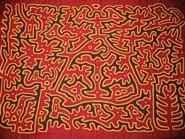
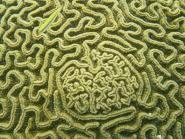
"Strongest on record"
Tuesday, October 18, 2005
British and Nigerian corruption
| |
...Amid the mutual congratulation, it is worth taking a moment to compare the impressive-sounding numbers with another figure that originates in
Monday, October 17, 2005

Why not bomb them today?
"The most important event of the second half of the 20th century is one that didn't happen." - Tim Harford quotes Thomas Schelling in an introduction to his work.
An unstated question, but ones that presumably occupies Schelling's fellow prize winner and others, is whether uncertainty about the use of nuclear weapons in the Middle East enhances or reduces stability.
Harford also notes:
"Schelling has involved himself in the debate on climate change. Often painted as a straightforward sceptic, his views are far more subtle. A short essay he wrote in 2002 for Foreign Policy argued for immediate action ..., but he also – as always – looked at the problem with fresh eyes, emphasising the fact that the climate change debate was fundamentally an argument about sharing costs and benefits."
An unstated question, but ones that presumably occupies Schelling's fellow prize winner and others, is whether uncertainty about the use of nuclear weapons in the Middle East enhances or reduces stability.
Harford also notes:
"Schelling has involved himself in the debate on climate change. Often painted as a straightforward sceptic, his views are far more subtle. A short essay he wrote in 2002 for Foreign Policy argued for immediate action ..., but he also – as always – looked at the problem with fresh eyes, emphasising the fact that the climate change debate was fundamentally an argument about sharing costs and benefits."
The great confusion
"If you have a sign out for the sermon 'Our obligation to the poor,' you won't get anybody. If you have a sign out for 'The Internet and the Antichrist,' you'll bring them in" - Prof Craig C. Hill quoted by Michael Luo in Doomsday: The Latest Word if Not the Last.
Publish and be damned
"This is extremely foolish. The genome is essentially the design of a weapon of mass destruction. No responsible scientist would advocate publishing precise designs for an atomic bomb, and in two ways revealing the sequence for the flu virus is even more dangerous".
Ray Kurzweil and Bill Joy on the publication of the full genome of the 1918 influenza virus on the Internet in the GenBank database by the United States Department of Health and Human Services.
Ray Kurzweil and Bill Joy on the publication of the full genome of the 1918 influenza virus on the Internet in the GenBank database by the United States Department of Health and Human Services.
Sunday, October 16, 2005
Apple pie
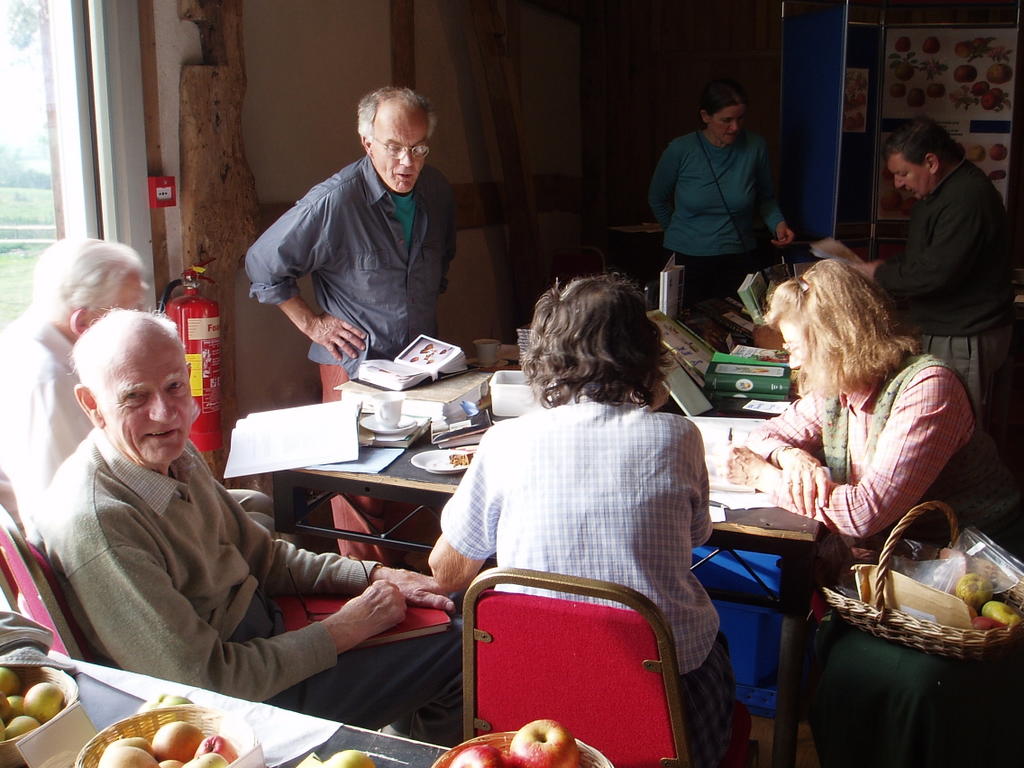
 Varieties of apples displayed in the Great Barn at Hellens at the Big Apple festival in Much Marcle, Herefordshire this weekend.
They are just part of the range of fruits recorded in the Herefordshire Pomona, and brought to prominence by the Marcher Apple Network.
As you can see from the lower photograph, the members of this sinister network are fomenting a conspiracy to undermine the Western way of life by nibbling away at the profits of leading corporations - and hence our very sense of what we are. If ever there was a case for preventive action , this is it.
Subscribe to:
Posts (Atom)