Friday, September 30, 2005


Thursday, September 29, 2005
Has the world just changed
...thanks to a robust laptop for children for under $100?
Imagine tens or even hundreds of millions of children wired up with these.
Imagine tens or even hundreds of millions of children wired up with these.
Order a copy now!
...of Debating Globalisation. Hey, order two! If you don't believe me, listen to "the boy" Kev:
"This book should be compulsory reading for governments, researchers, and social justice activists. The contributions address what is arguably the single greatest challenge of our age: the unstable co-existence of mass poverty in the midst of global prosperity. Avoiding simple blueprints, the book makes a compelling case for a new pattern of globalization and an end to 'business as usual' global governance". - Kevin Watkins, Director UNDP Human Development Report Office
Suspend your narcissism
"One of the novelties of Habermas's ...presentation 'Religion in the Public Sphere' was the commendable idea that 'toleration' -- the bedrock of modern democratic culture -- is always a two-way street. Not only must believers tolerate others' beliefs, including the credos and convictions of nonbelievers; it falls due to disbelieving secularists, similarly, to appreciate the convictions of religiously motivated fellow citizens. From the standpoint of Habermas's 'theory of communicative action', this stipulation suggests that we assume the standpoint of the other. It would be unrealistic and prejudicial to expect that religiously oriented citizens wholly abandon their most deeply held convictions upon entering the public sphere where, as a rule and justifiably, secular reasoning has become our default discursive mode. If we think back, for instance, to the religious idealism that infused the civil-rights movement of the 1950s and 1960s, we find an admirable example of the way in which a biblical sense of justice can be fruitfully brought to bear on contemporary social problems".
From Jürgen Habermas and Post-Secular Societies.
Wednesday, September 28, 2005
Climate surprises
A report released today (see also here) that Arctic sea ice has shrunk for a fourth consecutive year is striking but by no means surprising.
More unexpected, it seems, was Hurricane Catarina, which struck Southern Brazil in March 2004.
This, Fred Pearce reported last week, is "the first and only hurricane recorded in the South Atlantic, where the textbooks say hurricanes should not form". Hurricanes are not expected in the South Atlantic until 2070 so Catarina may be an ominous sign that global warming is already making itself felt.
More unexpected, it seems, was Hurricane Catarina, which struck Southern Brazil in March 2004.
This, Fred Pearce reported last week, is "the first and only hurricane recorded in the South Atlantic, where the textbooks say hurricanes should not form". Hurricanes are not expected in the South Atlantic until 2070 so Catarina may be an ominous sign that global warming is already making itself felt.
A force that gives us meaning
Andrew Brown's A new pornography of war is a must read (the URL in the Guardian's web version is mis-typed; it sould read www.nowthats[the rest]).
This takes one back to Chris Hedge's brillliant 2002 work War is a Force that Gives us Meaning, which is one of the few books on the topic to be studied closely and re-read.
This takes one back to Chris Hedge's brillliant 2002 work War is a Force that Gives us Meaning, which is one of the few books on the topic to be studied closely and re-read.
Keep digging
Last week a study from the National Commission on Energy Policy published a study identifying the ways in which the United States is most vulnerable to an oil shock. Among the key possible causes are thought to be political unrest in Nigeria and terrorist attacks in Saudi Arabia.
In today's tight conditions, taking just four per cent off the global oil market could cause the world price to go to $161 per barrel, the study says.
Reflecting on the challenges, James Surowiecki (on the financial page of The New Yorker, 26 Sep) reports that a greatly increased gasoline tax is the only measure that economists can agree on as certain to tackle the root cause of the problem - massively wasteful overconsumption.
Defining a high tax as progressive may seem counterintuitive, but this is only when you do not take into account the other ways in which [poor] people pay for apparently cheap petrol. (This point was well made to me by some academics on a recent visit to the US).
Surowiecki says:
"in political terms the gas tax's virtues - simplicity, tranparency, immediacy - are vices. Politicians prefer complex systems that allow them to satisfy particular constituencies, reward supporters, and disguise the true cost of things. And, strangely enough, voters implicity prefer indirect taxes to direct ones."
If one or both of these statements is or are true what prospect is there for reform in the US adequate to this most fundamental challenge? Are European nations and emerging powers really in any better position?
In today's tight conditions, taking just four per cent off the global oil market could cause the world price to go to $161 per barrel, the study says.
Reflecting on the challenges, James Surowiecki (on the financial page of The New Yorker, 26 Sep) reports that a greatly increased gasoline tax is the only measure that economists can agree on as certain to tackle the root cause of the problem - massively wasteful overconsumption.
Defining a high tax as progressive may seem counterintuitive, but this is only when you do not take into account the other ways in which [poor] people pay for apparently cheap petrol. (This point was well made to me by some academics on a recent visit to the US).
Surowiecki says:
"in political terms the gas tax's virtues - simplicity, tranparency, immediacy - are vices. Politicians prefer complex systems that allow them to satisfy particular constituencies, reward supporters, and disguise the true cost of things. And, strangely enough, voters implicity prefer indirect taxes to direct ones."
If one or both of these statements is or are true what prospect is there for reform in the US adequate to this most fundamental challenge? Are European nations and emerging powers really in any better position?
Bad dreams from the deep
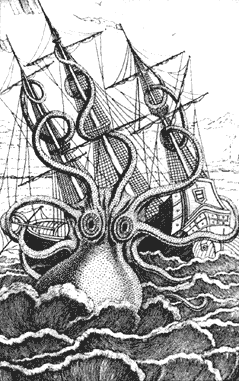
There's widespread excitement about some pretty blurry photographs of a giant (eighteen metre) squid taken some nine hundred metres down in the ocean (Live giant squid caught on camera).
Architeuthis and its cousin Mesonychoteuthis are the stuff of dreams - mostly nightmares as men have projected their fears on the animals in an environment beyond their control, and more recently as surreal fantasies in an industrialised world where people feel more physically secure (see, for example this image from - where else? - Exquisite Corpse). More bizarrely and grimly, they have even functioned as mules in the drug trade.
But the real magic of these animals is revealed by the science: they hunt by means of bioluminesence in dark waters, and battle with sperm whales - mammals like ourselves.
And the real nightmare, as the BBC reports, may be that bottom trawling in the deep oceans is destroying squid breeding grounds, wiping out the animal and so starving the whales which depend on them. This would be the real snuff movie.
Tuesday, September 27, 2005
Scopes 2
Laurie Goodstein does a good job of setting the scene for the "intelligent design" (ID) trial which opened in Harrisburg Pennsylvania on 26 Sep (A web of faith, law and science in evolution suit).
I felt a pang of regret on reading this yesterday because for some time I contemplated attending the trial. In the end I decided to concentrate on another project, but I will be sorry to miss what promises to be high drama.
Drawing on Laurie Goodstein's article, here are two points that look key to me:
The Supreme Court ruled in 1987 that teaching creation science in public schools was unconstitutional because it was based on religion. The plaintiffs will therefore - I guess - have to show beyond reasonable doubt that so-called "intelligent design" is based on religion. Showing it has no relation to science will be the easy part; but will that be enough in law?
The real issue here is not ID but social control, economic instability and deprivation. As the former science teacher and plaintiff Christy Rehm is reported as agreeing, the fuss over evolution "has obscured more pressing educational issues" like school financing, low parent involvement and classes that still train students for factory jobs as local plants are closing.
I felt a pang of regret on reading this yesterday because for some time I contemplated attending the trial. In the end I decided to concentrate on another project, but I will be sorry to miss what promises to be high drama.
Drawing on Laurie Goodstein's article, here are two points that look key to me:
The Supreme Court ruled in 1987 that teaching creation science in public schools was unconstitutional because it was based on religion. The plaintiffs will therefore - I guess - have to show beyond reasonable doubt that so-called "intelligent design" is based on religion. Showing it has no relation to science will be the easy part; but will that be enough in law?
The real issue here is not ID but social control, economic instability and deprivation. As the former science teacher and plaintiff Christy Rehm is reported as agreeing, the fuss over evolution "has obscured more pressing educational issues" like school financing, low parent involvement and classes that still train students for factory jobs as local plants are closing.
Costs of CCS
Monday, September 26, 2005
Kurzweil's singular dreaming
"....by the mid 2020s we will be able to meet our energy needs using very inexpensive nanotechnology-based solar panels that will capture the energy in the 0.03 per cent of the sunlight that falls on the Earth, which is all we need to meet our projected energy needs in 2030".
from Human 2.0, an article for the 24 Sep New Scientist by Ray Kurzweil - a useful introduction to his views on "the singularity" which quotes Stanislaw Ulam from 1958 -"an ever accelerating progress of technology...which gives the appearance of approaching some essential singularity...beyond which human affairs, as we know them, could not continue".
from Human 2.0, an article for the 24 Sep New Scientist by Ray Kurzweil - a useful introduction to his views on "the singularity" which quotes Stanislaw Ulam from 1958 -"an ever accelerating progress of technology...which gives the appearance of approaching some essential singularity...beyond which human affairs, as we know them, could not continue".
Blair and Kyoto
There's been quite a to-do since it was reported that Tony Blair has "changed his thinking" about the Kyoto Protocol. Jonathon Porritt was among those who came thundering back today with "we have to do both" (i.e. innovation *and* targets).
It would be striking if the Prime Minister were to throw out the results of ten years of the best efforts and international negotiation, and the considered and settled policy of his government and its allies - not least as activity gathers pace in the US for cap-and-trade to a target and timetable (either - as with North East power generators - to a Kyoto limit, or to some more relaxed target).
But it's probably wise not to overestimate the significance of his statement. Britain is bound under international treaty to the Kyoto target that it now looks likely to miss. There are number of actors with a significant financial investment in the European Trading Scheme who would be likely to align with a wider political constituency to give him and the UK government a hard time if his remarks proved to be more than musing.
And it's important to recognise that "post-Kyoto" is highly uncertain, as EU Environment Commissioner Stavros Dimas acknowledged late last week.
(note: Life Beyond Oil - a New Statesman supplement on UK energy edited by Emily Mann, and with my contribution on "more intelligent" energy use is now up on the web here)
(note 2: a second shaft of light on Blair's thinking is evidenced by remarks reported from Bill Clinton's parallel summit - see Jonathan Freedland here)
It would be striking if the Prime Minister were to throw out the results of ten years of the best efforts and international negotiation, and the considered and settled policy of his government and its allies - not least as activity gathers pace in the US for cap-and-trade to a target and timetable (either - as with North East power generators - to a Kyoto limit, or to some more relaxed target).
But it's probably wise not to overestimate the significance of his statement. Britain is bound under international treaty to the Kyoto target that it now looks likely to miss. There are number of actors with a significant financial investment in the European Trading Scheme who would be likely to align with a wider political constituency to give him and the UK government a hard time if his remarks proved to be more than musing.
And it's important to recognise that "post-Kyoto" is highly uncertain, as EU Environment Commissioner Stavros Dimas acknowledged late last week.
(note: Life Beyond Oil - a New Statesman supplement on UK energy edited by Emily Mann, and with my contribution on "more intelligent" energy use is now up on the web here)
(note 2: a second shaft of light on Blair's thinking is evidenced by remarks reported from Bill Clinton's parallel summit - see Jonathan Freedland here)
Friday, September 23, 2005
A good cause
 The oil for ape campaign calls for:
- an immediate end to all forest conversion to oil palm;
- recognition of the customary land rights of local people;
- reform of UK company law.
As for land rights for local people, well, yes, but be real about the way political power operates.
This scientist agrees, however, that pressure applied to big companies in consumer countries can work. It just needs to be well directed. So it may be that the third demand, timed as it is for the Company Law Reform Bill, can be more gounded.
FOE is bold here, with "every little hurts". How's about those words on banner beneath a picture like this outside your local branch of Tesco's?
But what about the rest of big consumer country oil palm demand - the other [90% or more?] in continental Europe, the US, Japan, China etc?
Not cheerful
Iraq "disintegrating"
"There is no dynamic now pulling the nation together ...All the dynamics are pulling the country apart." - Saudi foreign minister Prince Saud al-Faisal speaking at the Saudi embassy in Washington on 22 Sep.
"A bit of oomph"
"We may need the skills of Zimbabwe to help us" - South African deputy president Phumzile Mlambo-Ngcuka on the need for land reform (reported 23 Sep) .
Thursday, September 22, 2005
UK exiting Iraq?
The dramatic events in Basra highlight the need for serious public analysis and debate about ways forward in Iraq - as more people begin to consider British presence unsustainable.
William Shawcross and Simon Jenkins on Newsnight on 21 Sep were marginally more useful than Galloway and Hitchens last week. It was striking how emphatic General Sir Michael Rose was on the same programme about the need to set a date to get out (and sticking to it).
Anne Clywd, currently Tony Blair's special envoy to Iraq, is an honourable person (Hitchens said last week that she has no memory of Galloway's presence among those championing the Kurdish cause when they most had need of friends in the 1980s), but her line about the "excellent" elections in Basra earlier this summer and the need to be patient looks less plausible as the extent of corruption and conflict become ever clearer.
I would like to understand more about how the various Shi'ia factions are lining up, and where this could lead. How far can Muqtadr al-Sadr and his allies go, and where will reported clashes with the Badr brigades, which are said to be both backed by Iran and loyal to the Baghdad government, go? Any pointers to more sound analysis welcome.
Quite robust, I think, was Donald Philips [?], formerly with the State Deparment [?] and now at Harvard University[?]. He told The World Tonight on 21 Sep that while every effort must be made to support the political process and reconstruction, it would be untenable to leave thousands of western troops in the crossfire of a full blown civil war. The best option was likely to be for western forces to withdraw north of the 35th parrallel and protect a Kurdish state as the "frontline in the forward march of freedom". Ho ho.
(Some insight comes from Peter Galbraith, previously noted here, and for an account of one serious attempt to grapple with the dilemmas see Confessions of a Humvee Liberal)
William Shawcross and Simon Jenkins on Newsnight on 21 Sep were marginally more useful than Galloway and Hitchens last week. It was striking how emphatic General Sir Michael Rose was on the same programme about the need to set a date to get out (and sticking to it).
Anne Clywd, currently Tony Blair's special envoy to Iraq, is an honourable person (Hitchens said last week that she has no memory of Galloway's presence among those championing the Kurdish cause when they most had need of friends in the 1980s), but her line about the "excellent" elections in Basra earlier this summer and the need to be patient looks less plausible as the extent of corruption and conflict become ever clearer.
I would like to understand more about how the various Shi'ia factions are lining up, and where this could lead. How far can Muqtadr al-Sadr and his allies go, and where will reported clashes with the Badr brigades, which are said to be both backed by Iran and loyal to the Baghdad government, go? Any pointers to more sound analysis welcome.
Quite robust, I think, was Donald Philips [?], formerly with the State Deparment [?] and now at Harvard University[?]. He told The World Tonight on 21 Sep that while every effort must be made to support the political process and reconstruction, it would be untenable to leave thousands of western troops in the crossfire of a full blown civil war. The best option was likely to be for western forces to withdraw north of the 35th parrallel and protect a Kurdish state as the "frontline in the forward march of freedom". Ho ho.
(Some insight comes from Peter Galbraith, previously noted here, and for an account of one serious attempt to grapple with the dilemmas see Confessions of a Humvee Liberal)
Luck
A graphic of strike probabilities from NOAA shows a 32 to 70% probability (as of 7am CDT) of it not hitting the US coast from roughly the Lousiana/Mississippi border to Texas at about Corpus Christi (but rather hitting the coast to the east or south west of that part of the Gulf coast).
Anniversary
"...all persons held as slaves within any State, or any designated part of a State, the people whereof shall then be in rebellion against the United States shall be then, thenceforward, and forever, free."
Emancipation Proclamation, 22 Sep 1862 - not before time in the Slave Nation.
Emancipation Proclamation, 22 Sep 1862 - not before time in the Slave Nation.
Subscribe to:
Posts (Atom)