Tuesday, September 24, 2013

Minotaur


I submitted a piece to Comment is Free at The Guardian. They didn't take it. Here it is.

Into the Labyrinth

The Book of Imaginary Beings by Jorge Luis Borges has many monsters. Among them is the Minotaur, half bull and half man, who is born of the furious passion of Pasiphae, Queen of Crete, for a white bull that Neptune had brought out of the sea. Daedalus, the engineer and craftsman who invented the artifice that carried the Queen's unnatural desires to gratification, builds a labyrinth to hide her monstrous son. But the consequences of her act cannot be confined. The Minotaur feeds on human flesh and every year seven young men and seven maidens must be thrown into its lair.

The relevance of this old myth to anthropogenic climate change and the new [27 September 2013] report from Working Group 1 of the Intergovernmental Panel on Climate Change is not obvious. The IPCC report is the best effort of the international scientific community to summarise current understanding of the complex phenomena involved. Like all such endeavours, it is necessarily provisional and imperfect. But, notwithstanding the distortions and lies manufactured and propagated by the fossil fuel lobby and its friends, it is a small triumph of cooperation and the rational method that are hallmarks of the Enlightenment and progressive thought. It may even, in combination with much else, help deliver effective responses to one of the greatest challenges any generation has faced.

Ancient myths, by contrast, resonate with our emotions and the associative parts of our minds, but their meanings are often slippery and can disappear if we try to confront them directly. They seldom offer clear markers as to what to do. But myths that have endured are still with us for good reason. They contain profound truths about the human condition. They allow us to inhabit alternative worlds or forgotten corners of experience. And they are open to divergent, inconclusive interpretations.

You can see this in Pablo Picasso's work. In Minotauromachy, etched in March 1935 some fifteen months before Spain waded into the bloody nightmare of civil war, a terrifying figure with the head of a bull and the body of a massively powerful man has gored open a horse which carries a bare-breasted and unconscious or dying torera (a female bullfighter) on its back. A Christ-like figure flees up a ladder while from a window onlookers do nothing. Only a young girl, holding a bunch of flowers and a candle lit against the darkness, stands in the monster's path. Elements of this etching prefigure the famous 1937 painting Guernica. But at the same time that he created Minotauromachy, Picasso was also celebrating the Minotaur in a series we know as the Vollard Suite in which the hybrid beast embodies disruptive male sexuality, and even vulnerability and tenderness.

The relevance to manmade climate change is that even when things look grim we cannot know for sure how they will turn out. This is not because the science is faulty but because in science and human affairs uncertainty is inevitable. Climate science can only assign a range of probable outcomes under a given scenario such as the doubling of atmospheric concentrations of CO2. Human behaviour, which may result in concentrations significantly higher or lower than that, is much harder to predict.

The IPCC report estimates that the global average temperature is likely to rise by between 1 and 4 ºC [CHECK] for a doubling of CO2. Even at the lower end of these projections of what is known as climate sensitivity, we face a massive risk management challenge. Already, before the change has kicked in, we are seeing extreme weather events and rapid regional warming that suggest more formidable challenges ahead. (Climate change may be a factor behind the  conflict in Syria: according to the UN, two to three million of Syria’s ten million rural inhabitants were reduced to extreme poverty by an exceptionally severe drought between 2006 and 2010, with large-scale anger and unrest a result.) And towards the upper end of the IPCC range, which the report deems no less probable, the prospects are far more disturbing.

Moreover, there is evidence that assumptions on climate sensitivity made in the latest IPCC report underestimate the role of some amplifying feedbacks that intensify climate impacts. In other words, reality may be vastly more disruptive than the IPCC suggests. Paul Wignall, professor of paleoenvironments at Leeds University, reckons the current rate of change is a good match for the beginning of the end Permian extinction 251 million years ago when the temperature rose by around 6ºC and 95% of species died. If this sounds almost incredible consider that the additional accumulation of heat in the oceans since the 1870s due to human activity is equivalent to 10 billion Hiroshima bombs. Half of that energy has been added since 1970 at an average rate of about 4 atomic bomb detonations per second. “The climate system is an angry beast,” observed the distinguished scientist Wally Broecker in 2008, “and we are poking it with a sharp stick.”

The world in which we evolved is filled with almost endless forms of life most beautiful and most wonderful: beings so astonishing in their variety and sophistication that, for all our science and ingenuity to date, we have still barely imagined them. In the words of the science writer David Biello, “butterflies hold answers to questions we haven’t even thought to ask yet.” Another mass extinction will destroy huge resources of knowledge and wonder.

Life has survived at least five mass extinctions in the distant past. Each one opened opportunities for marvelous new forms to evolve. The rise of the mammals after the demise of the dinosaurs some 66 million years ago is the best known example. But recovery – in our case the evolution of a world with great whales, stunning coral reefs, more than ten thousands bird species, and ourselves – took millions of years.  De-extinction technology may resurrect a few iconic species, and perhaps more, but it is no substitute for responsible stewardship of the fantastic complexity and beauty we already have.

Almost everything depends on what we do now. Theseus had to be brave when he entered the labyrinth to slay the Minotaur but bravery alone was not enough. He also needed the technical means to escape – a thread provided on the advice of Daedalus by prince Ariadne. In our time, a vision for justice is essential but so is technical advance. Rational people can negotiate over priorities but they are likely to include radical transformations in the energy system such as the delivery of PV at less than a dollar a Watt, a new vision for land use and ecosystem management. Perhaps we will need to get serious about a plan B: geo-engineering.

In one of his more pessimistic moments Friedrich Nietzsche wrote, “I fear that the animals see man as a being who in a most dangerous manner has lost his animal common sense – as the insane animal, the laughing animal, the weeping animal, the miserable animal.” It is up to us to create a different reality. Regarding situations that looked hopeless, the economist Albert O. Hirschman talked of “possibilism” – a state of mind that allows one to discover paths that “however narrow, [lead] to an outcome that appears to be foreclosed on the basis of probabilistic reasoning alone.”  Hope, not least in defiance of the terrific power of vested interests and the dismal influence of climate contrarians, is our greatest resource.


Monday, September 02, 2013

The good old days

From report to Parliament in 1842 (quoted here):
Collieries.—“I wish to call the attention of the Board to the pits about Brampton. The seams are so thin that several of them have only two feet headway to all the working. They are worked altogether by boys from eight to twelve years of age, on all-fours, with a dog belt and chain. The passages being neither ironed nor wooded, and often an inch or two thick with mud. In Mr. Barnes’ pit these poor boys have to drag the barrows with one hundred weight of coal or slack sixty times a day sixty yards, and the empty barrows back, without once straightening their backs, unless they choose to stand under the shaft, and run the risk of having their heads broken by a falling coal.”—Report on Mines, 1842, p. 71. “In Shropshire the seams are no more than eighteen or twenty inches.”—Ibid., p.67. “At the Booth pit,” says Mr. Scriven, “I walked, rode, and crept eighteen hundred yards to one of the nearest faces.”—Ibid. “Chokedamp, firedamp, wild fire, sulphur, and water, at all times menace instant death to the laborers in these mines.” “Robert North, aged 16: Went into the pit at seven years of age, to fill up skips. I drew about twelve months. When I drew by the girdle and chain my skin was broken, and the blood ran down. I durst not say anything. If we said anything, the butty, and the reeve, who works under him, would take a stick and beat us.”—Ibid. “The usual punishment for theft is to place the culprit’s head between the legs of one of the biggest boys, and each boy in the pit—sometimes there are twenty—inflicts twelve lashes on the back and rump with a cat.”—Ibid. “Instances occur in which children are taken into these mines to work as early as four years of age, sometimes at five, not unfrequently at six and seven, while from eight to nine is the ordinary age at which these employments commence.”—Ibid. “The wages paid at these mines is from two dollars fifty cents to seven dollars fifty cents per month for laborers, according to age and ability, and out of this they must support themselves. They work twelve hours a day.”-Ibid.

Friday, August 30, 2013

Review of Birds and people

Nunivak man with raven maskette

I've written a review of Birds and People by Mark Cocker for the September edition The Literary Review. The text is online here.

Man came to awareness surrounded by birds.
                                                          — Graeme Gibbons

From Barely Imagined Beings: Evolving with a Mountain

Thursday, August 29, 2013

Surrounded by more or less ghostly objects


This is the second of two posts relating to The Death and Life of the Frontier, an article published in the first quarterly (print) edition of Nautilus. It expands on a couple of points in the last paragraphs of the article, marked here in bold. The first set of notes is here. An excerpt from the article is online here.

We should not dismiss our potential to innovate more intelligently and benignly in the future than has been the case in the past. 

In Arctic Dreams Barry Lopez reports a reflection from an archaeologist on the legacy of long-gone indigenous peoples of the high North: “Everything we are is in our spirit.”  Some poets in our own culture have said as much. Henry David Thoreau wrote:
Time is but the stream I go a-fishing in. I drink at it; but while I drink I see the sandy bottom and detect how shallow it is. Its thin current slides away, but eternity remains. I would drink deeper; fish in the sky, whose bottom is pebbly with stars. I cannot count one. I know not the first letter of the alphabet. I have always been regretting that I was not as wise as the day I was born. 
Richard Jefferies wrote
Time has never existed, and never will; it is a purely artificial arrangement. It is eternity now, it always was eternity, and always will be.
Dreams can contain much darkness as well as light. Lopez describes a find at an Ipiutak burial site at Point Hope, Alaska:
A small carved caribou hoof was protruding on a shaft from the pelvic region of a human skeleton. Clearing away more earth revealed that this long ivory shaft penetrated the entire vertebral column and emerged in the skull, where it curved forward in space where the mouth would have been. It terminated in a miniature hand, opened in supplication. 

With our vastly greater knowledge and capabilities, what else might we yet conceive?

The physicist David Deutsch suggests that the human capacity to explain the fabric of reality may one day give our successors the ability to extend the duration of a main sequence star such as the Sun. This is a staggering thought, perhaps a hopeful one. One thinks of Thoreau at his happiest, writing next to his beloved “ Earth's eye,” Walden Pond:
These may be but the spring months in the life of the race...The sun is but a morning star.
But there are other, bleaker possibilities. Stanisław Lem warns:
Someone who is capable of switching stars on and off will also be capable of annihilating whole inhabited globes, transforming himself in this way...[into] a criminal on a cosmic scale.
Wade Davies is more hopeful:
The path we have taken is not the only one available. Our destiny...is not indelibly written in a set of choices that demonstrably and scientifically have proven not to be wise. By their very existence the diverse cultures of the world bear witness to the folly of those who say that we cannot change, as we all know we must, the fundamental manner in which we inhabit this planet.
Jonathan Bate writes:
The dream of deep ecology will never be realised here on Earth, but our survival as a species may be dependent on our capacity to dream it in the work of our imagination.

Image: Figures in Red Boat by Peter Doig

Elephants all the way around


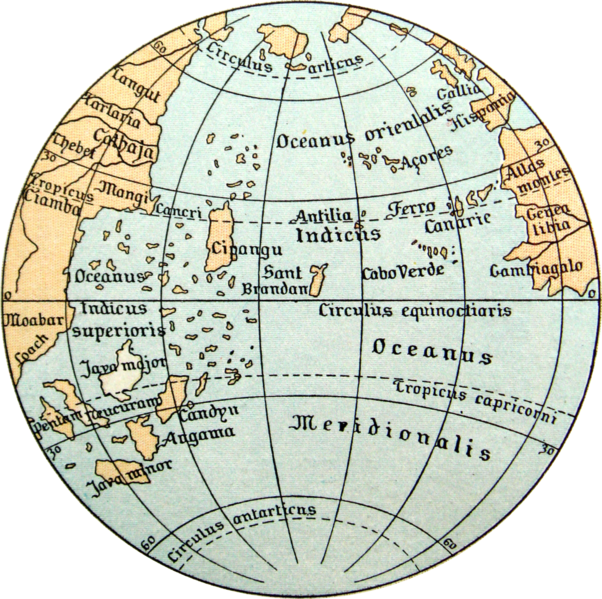
The Erdapfel: Sail west from Lisbon and your landfall is in Japan

Here is the first of two sets of notes relating to The Death and Life of the Frontier: a Voyage to the Limits of the Knowable, an article I've written for the first quarterly (print edition) of Nautilus. An excerpt from the article is online here. The second set of notes is here.

Aristotle noted... [that] constellations on the southern horizon rise in the sky as you travel south.
He added, drily, that the Earth must be a sphere “of no great size, for otherwise the effect of so slight a change of place would not be quickly apparent” in the position of the constellations. The first known attempt to measure the Earth's circumference was undertaken by Eratosthenes in around 240 BC. He compared the angle of a shadow cast at noon in Alexandria to one made simultaneously at Syene (modern day Aswan) nearly 500 miles due south and derived an estimate accurate to within 2% of the actual value, 24,860 miles. 

The Erdapfel...a terrestrial globe made in Nuremberg in 1492
This was not the first globe to be made since the fall of classical civilization. The Persian-speaking astronomer Jamal ad-Din had presented one to Kublai Khan in Beijing in 1267. But it is the oldest to survive. 

Prehistory’s almost unimaginably vast contours.
A sense that the world is massively old is not new. Aristotle believed it was eternal. “Where the dust blows through these heights there once shone a silent sea,” writes [wrote] a Chinese poet of the first millennium. Hindu cosmology teaches that the universe and the world are created, destroyed and re-created in cycles of about 4.32 billion years. But such accounts were intuitive and impressionistic. 

Darwin's vision...was not, in the end bleak.
In addition to being an intellectual triumph the theory of natural selection was grounded in compassion and humility.  The full quote from Darwin, with emphasis added here, is:
let man visit Ouranoutang in domestication, hear its expressive whine, see its intelligence when spoken to; as if it understands every word said; see its affection to those it knew; see its passion & rage, sulkiness, & very actions of despair; ... and then let him boast of his proud pre-eminence ... Man in his arrogance thinks himself a great work, worthy the interposition of a deity. More humble and I believe true to consider him created from animals.
Darwin's theory has been applied with success in fields as diverse as drug design and artificial intelligence. There is even a hypothesis of cosmological natural selection, in which black holes (surely one of the most imposing frontiers we know of in the universe) are mechanisms of reproduction for multiple universes within a multiverse.

Chimpanzees grieve for non-related individuals.
[Maggie Koerth-Baker writes]: Brian Hare, an evolutionary anthropologist at Duke University, is convinced that an ape death he witnessed gave him a glimpse into something significant, especially because the animals acted so thoroughly against their own interests. “As a person, I can tell you what it feels like to watch,” says Hare, who describes the experience as emotionally intense. “As a scientist, though, you’re supposed to rely on ideas that can be tested and falsified. And how could you possibly do an ethical experiment here?” Hare studies how chimpanzees and bonobos solve problems, and in 2007 he happened to see one of our closest evolutionary relatives die. He was at a bonobo orphanage in the Democratic Republic of Congo when Lipopo, a newcomer to the orphanage, died unexpectedly from pneumonia. Although the other bonobos could have moved away from his body and traveled anywhere in their very large, heavily forested enclosure, they chose to stay and groom Lipopo’s corpse. When their caretakers arrived to remove the body, the vigil morphed into a tense standoff. 
In the video Hare took, Mimi, the group’s alpha female, stands guard over Lipopo’s body. When the caretakers try to push the corpse out of the enclosure with long poles, Mimi fights them, viciously. She grabs the poles with both hands, wrenching them away from Lipopo. She calls to other bonobos, who help her fend off the humans from two sides. Even when the vet arrives with a tranquilizer gun, Mimi stands her ground, her mouth open wide in a scream that’s inaudible in the silent film. Mimi wasn’t related to Lipopo. In fact, she barely knew him, Hare told me. But Mimi was willing to risk an encounter with a gun to protect the body of a mere acquaintance. “That’s why I started to cry,” Hare said. “I don’t know why she did it.” 

Microbes in stupendous abundance.
Micro-organisms may have played a role in keeping conditions on Earth favourable for the continued flourising of life almost since inception. The geologist Minik Rosing suggests that early in the planet's history they accelerated the geological process that led to the formation of Earth's continents through the production of lubricating clays. This allowed for the steady and continuous churning of minerals useful to life from within the Earth's mantle.

Who would object to 100 or even 120 years of healthy...life?
See (e.g.) The Case for Enhancing People by Ronald Bailey. The Pew Research Centre found that when asked whether they, personally, would choose to undergo medical treatments to slow the aging process and live to be 120 or more, a majority of U.S. adults (56%) say “no.” But roughly two-thirds (68%) think that most other people would. 

The Singularity
Ray Kurzweil sees no barrier to the supposedly imminent emergence of intelligence vastly superior to humans via technological means – Kurzweil believes “we will become the machines” and that this is a good thing. Consciousness, uploaded onto computers, will become eternal. Lost loved ones will even be restored to life in a computer simulation that seems just as real to those within it as our world does to us.

There is any number of things one could say about Kurzweil's vision. Here are three. First, his vision may be at least as, if not more probable than the world envisaged in the Terminator and Matrix films in which hostile intelligent machines take over. Although robots are likely to become increasingly able to learn and evolve, it is hard to see how genuine autonomy will come to pass. Systems that look autonomous will probably be the creatures of states, corporations or other actors including criminals for a long time to come.

Second, most scientists who study the human brain are deeply sceptical of Kurzweil's claims about the feasibility of uploading one, at least for the next several decades. David J Linden, professor of neuroscience at The Johns Hopkins University School of Medicine, writes that “Kurzweil [confuses] biological data collection with biological insight. The unstated but crucial foundation of [his] scenario requires that at some point in the 2020s a miracle will occur...” Gary Marcus, a professor of psychology at N.Y.U., says “Kurzweil doesn’t know neuroscience as well as he knows artificial intelligence [which is not well], and doesn’t understand psychology as well as either.”

Third, despite these objections there is a chance, and in my view a good one, that something with a passing resemblance to what has unkindly been called the rapture for nerds will eventually come to pass, albeit not within several decades. As the engineer and futurist Roy Amara famously said, “we tend to overestimate the effect of a technology in the short run and underestimate the effect in the long run.” If computers go on getting faster and better at learning – something that is likely to happen even without the development of quantum computing (which really would be a game changer) – and if the right conditions and selective pressures are in place, then the sky's the limit. 

The Anthropocene is likely to be a time of rapid and unpredictable environmental change.
Among the triggers of change may be runaway global warming via mechanisms such as a rapid release of arctic methane.

end Permian
I asked Paul Wignall about recent press reports (here and here) suggesting a meteorite played a role. He replied:
Ah yes I guess [this] paper, just available online, is what is attracting all the media attention. The authors still have the problem that the crater is too old, allowing for the error bars they can special plead that it could just about be the right age. Other problems are that gas hydrates (their preferred source of methane) are not usually found in such large amounts in shallow basins, they are more typical of deep continental slopes. Again special pleading could just possibly make an exception. And would a meteorite impact cause fracking? Who knows but I like the convergence of past and present worries!

Perhaps, one day, an abundance of elephants in the most surprising places will be part of our world again.
See Yadvinder Malhi on the legacy of lost giants and Gomphotheres of the Rambunctious Garden. If Malhi is right restoring elephants could increase the resilience of rainforests.  (Also, here's the reference for "It's the Ecology Stupid")

Biodiversity loss is a systemic phenomenon 
Bill Adams quotes this line from a paper published in Nature in 2013 which quantified the ways in which threats to 25,000 endangered species on IUCN Red Lists were linked to the production of 15,000 commodities in 187 countries via more than 5 billion supply chains. Adams continues: 
The economic machine that consumes biodiverse habitat has its foundation in the world economy. As that economy grows, demands made on the biosphere increase. Particularly in the rapidly industrialising countries of Asia, the standard economic growth model is having some success in helping people to escape poverty, and others to become rich. This is admirable but also, for a conservationist, very disturbing. Global consumption of raw material and energy (and production of wastes) has risen inexorably. Poor countries pursue the model of the rich, and poor people, understandably, dream of becoming wealthy. The problem is that biodiversity shrinks before the combined onslaught of people and wealth. The Western model of consumption is unsustainable for any but a few, and the model has to change in rich and poor countries. Focusing conservation efforts on residual pristine landscapes is a way to treat symptoms not causes. It is displacement behaviour.  the real issues are elsewhere.

What else might we yet conceive? 
Committing ourselves to a small change, even one that is unmistakably in our best interest, is often more frightening than ignoring a dangerous situation.

You must change your life. Peter Solterdijk writes:
Whoever has not been seized by the concept of the oversized does not belong to the species Homo sapiens. The first hunter in the savannah was already a member; he raised his head and understood that the horizon is not a protective boundary, but rather a gate for the gods and dangers to enter.

Friday, August 23, 2013

Syria


The list is enough in itself

Boy foaming at the mouth
Pictures

Monday, July 15, 2013

Sandpiper


Every few months, it seems, I stumble across a poem by Elizabeth Bishop that I had not read before. Here, via Brandon Keim's essay on animal consciousness, is Sandpiper
The roaring alongside he takes for granted,
and that every so often the world is bound to shake.
He runs, he runs to the south, finical, awkward,
in a state of controlled panic, a student of Blake.

The beach hisses like fat. On his left, a sheet
of interrupting water comes and goes
and glazes over his dark and brittle feet.
He runs, he runs straight through it, watching his toes.

- Watching, rather, the spaces of sand between them
where (no detail too small) the Atlantic drains
rapidly backwards and downwards. As he runs,
he stares at the dragging grains.

The world is a mist. And then the world is
minute and vast and clear. The tide
is higher or lower. He couldn't tell you which.
His beak is focussed; he is preoccupied,

looking for something, something, something.
Poor bird, he is obsessed!
The millions of grains are black, white, tan, and gray
mixed with quartz grains, rose and amethyst.
Image: Sanderling, RSPB

Friday, July 12, 2013

Helicos-pteron

A striking short film of a human powered helicopter has been posted by AeroVelo

I touched on the history of the helicopter in a much longer early draft of the Quetzalcoatlus chapter for The Book of Barely Imagined Beings. This is footnote 74 (of 117):
There is, of course, at least one ‘helicopter’ in nature: winged seeds such as that of the sycamore . One of the strangest and least successful flying machines of all time was directly inspired by it. Designed in 1913-14, the Papin-et-Rouilly Gyroptère consisted of rotary engine sucked in air that was piped through a duct inside a single large swept wing where it exited through a nozzle in the trailing edge. This propelled the wing in a clockwise spinning motion around the pilot, who sat in the middle inside a drum mounted on ball bearings, with a doughnut-shaped float underneath. A swiveling air nozzle, which the pilot manipulated to steer the machine, also provided forward thrust. On its first test flight on Lake Cercey in eastern France in 1915, the Gyroptere wing rotated fast enough for the pilot to loose control but not fast enough to take off, and the whole contraption sank.

Helicopters have a longer and stranger history than many people realise. It probably starts with a child’s flying top, the ‘bamboo dragonfly’, which was developed in China in about the year 400 AD. Sophisticated models with, respectively a coaxial rotor and counter rotating rotors using turkey feathers as rotor blades, were demonstrated at the Russian and French academies of science in 1754 and 1783. The word ‘helicopter’ - from the Greek "helicos" meaning helix and "pteron" meaning wing - was coined in the early 1860s by the Viscomte de Ponton d'Amecourt, who demonstrated a small steam-powered model. In 1901 the Slovak inventor Ján Bahýľ developed the first model helicopter powered by an internal combustion engine and in 1905 succeeded in getting it to fly more than 1,500 meters at an altitude of about four meters. And in 1907 two French brothers, Jacques and Louis Breguet, got a piloted craft two feet (0.6 m) into the air for about a minute.

Great strides were made over the next two decades, but the first truly reliable and practical helicopter, the Focke-Wulf Fw 61, didn’t fly until 1936 and was demonstrated indoors at the Deutschlandhalle sports stadium in Berlin in 1938 by Hannah Reitsch, Hitler’s favourite test pilot. Later that year she set an altitude record of 3,427 m and a straight line flight record of 230 km. The Third Reich was the first power to use helicopters in war, with a small number deployed for observation, transport, and medical evacuation.
The first human-powered helicopter, the Da Vinci III, flew on 10th December 1989 at California Polytechnic State University It was airborne for 7.1 seconds and reached a height of 20 cm (a little less than 8 inches). Two people had to hold the craft steady while it was in the air.
There were further references to Leonardo da Vinci elsewhere in the text.

Monday, July 01, 2013

Wonders of a cell

Page 375 of The Book of Barely Imagined Beings touches very briefly on the extraordinary complexity of cells and cellular process. In a post titled Organized Chaos Brandon Keim writes (in a footnote):
the modeling of protein folding and unfolding described in this PNAS article was produced by a custom-designed, massively parallel piece of dedicated hardware roughly 100 times more powerful than any other machine used for this purpose. Running at full power over the course of a day, it can model ten microseconds of molecular cell dynamics. It would need to run for 2,737 years to describe one second.
Keim counsels against comparing cells to machines or factories:
The proteins of which they’re made don’t fold and unfold and operate according to some stepwise blueprints. Shape and function are exquisitely sensitive to infinitesimal energetic shifts, to the motion of atoms and the forces they exert. Rather than a cellular factory, then, imagine a restaurant with a kitchen where blenders turn into convection ovens and whisks into knives when someone walks by, raising ambient temperatures by a fractional degree. Imagine that the whole kitchen is like this, that cooks and prep staff, though they move with intent, can’t help but wander around—and still the seven-course meals come rolling through the doors.

Friday, June 28, 2013

"Memory can go further back..."

I think the memory of most of us can go farther back into such times than many of us suppose; just as I believe the power of observation in numbers of very young children to be quite wonderful for its closeness and accuracy. Indeed, I think that most grown men who are remarkable in this respect, may with greater propriety be said not to have lost the faculty, than to have acquired it; the rather, as I generally observe such men to retain a certain freshness, and gentleness, and capacity of being pleased, which are also an inheritance they have preserved from their childhood.
 -- from David Copperfield, recalled by Romesh Gunesekera

Thursday, June 27, 2013

Exterminate the brutes

The reviews for The Book of Barely Imagined Beings have been good (see, for example, here and here).  The book has been longlisted for the Royal Society science book prize and the Society of Authors Biology book prize (general category).

Customer reviews at amazon.com have been varied. Some have been disappointed that the pictures are only in black and white. Others have liked the text. William Suddaby of Sugarloaf Key,  Florida (More than a Bestiary, June 23, 2013) writes:
A book of cosmic importance. If you have ever wondered who are we, where are we, and where might we be going, this is a book for you. It is a delight to read and hold -- breathtakingly wise, startling, preeminently significant for the 21st Century. 
The most unfavourable review of which I am aware appears in the Good Reading Guide. Harely J Sims accuses me of anti-humanism and finds my sociopolitics obnoxious, associating me with “the extreme environmental and animal-rights movements.”

Mr Sims is welcome to find my sociopolitics obnoxious so long as he understands what they actually are. It is clear that at present has no idea. An epigraph for the book, and one which I quote most in talks, is from Montaigne:
The most barbarous of our maladies is to despise our being.
This speaks to an explicitly pro-human viewpoint and the celebration of human capabilities throughout the book. The fact that many of our capabilities are grounded in things we share with other animals does not diminish them.

I am not going to respond in detail to his criticism, much of which is daft, but I will take two points by way of illustration.

1) I do not write that giant sponges are the ancestors of human beings. To find what I actually write see page 31.

2) Sims takes issue with the description of the First World War as an occasion on which Europeans killed each other on a scale matched only by their destruction of native peoples overseas in the previous few decades. But consider the following:
Total casualties in the four years of WW1: about 37 million, of which 16m dead and ±20m wounded.
Starvation to death of peasants in late 19th century British India resulting from government policies: 30 to 60 million.
Deaths of natives in Congo caused by the Belgian regime, 1880/90s: 2 to 15 million.
During the Italian pacification of Libya a quarter of Cyrenaica's population was killed.
The Herero and Namaqua genocide by German forces in Southwest Africa 1904-1907  is recognized as the first genocide of the 20th century.
These are just a few examples from a much longer list of brutal policies and outright atrocities committed by the European colonial powers and the United States in the period 1850 to 1914, not to mention earlier outrages. Not all were deliberate acts of extermination. All were associated with policies intended to keep subject peoples under control and shore up imperial power.

Monday, June 24, 2013

Ignorance, confidence, knowledge


Ignorance more frequently begets confidence than does knowledge: it is those who know little, not those who know much, who so positively assert that this or that problem will never be solved by science.
-- Charles Darwin (1871)

Tuesday, June 18, 2013

The utopian goal of totalitarian secret police

 The modern dream of the totalitarian police, with its modern techniques, is incomparably more terrible [than that of its predecessors]. Now the police dreams that one look at the gigantic map on the office wall should suffice at any given moment to establish who is related to whom and in what degree of intimacy: and, theoretically, this dream is not unrealizable although its technical execution is bound to be somewhat difficult. If this map really did exist, not even memory would stand in the way of the totalitarian claim to domination; such a map might make it possible to obliterate people without any traces, as if they had never existed at all. 
-- from The Origins of Totalitarianism (1951) Hannah Arendt.  

Monday, June 17, 2013

Etymology, cognition, emotion

Words describing emotions appear to evolve either from words describing physical phenomena associated with the emotion or from the thing that inspires the emotion. Regret literally means “to weep again,” from such words as Old English graetan and Proto-Germanic gretan; and worry originally mean “to choke or strangle,” a meaning that can be traced all the way back to the Indo-European wērgh. Astounded and astonished evolved from the Latin verb tonare, meaning “thunder;” and fear doesn't acquire its emotional dimension until 1280, before which the Old English (faer) simply meant “danger” or “peril.”

In the realm of thought, the evolution of consider can be followed back ... to the Latin considerare meaning “to examine or contemplate,” deriving from an earlier meaning “to examine the stars,” which grew out of its root elements con (with) + sidus (star/constellation). Ponder can be traced to the...marketplace via Old French ponderer (to weigh or balance in a scale)...

The ancient Chinese mind underwent the same process of metaphoric self-creation as [the Western one], but its empirical origins remain apparent, for the ten thousand things are still visible in the pictographic nature of characters. Mind, for instance, is simply a picture of the heart in classical Chinese, because the thinking mind is not distinguished from the feeling heart...

To feel [in classical Chinese] is constructed of the character for “heart-mind” and the one for “the blue-green color of landscape”, a remarkable concept of color that includes both the green of plants and trees and nearby mountains, and the blue of distant mountains and sky. Hence, the “heart-mind in the presence of landscape-color” or “the landscape-color of heart-mind.” 
-- from Hunger Mountain by David Hinton

Saturday, June 15, 2013

The sea mysteries

Like an oyster hides its pearl,
The sea hides its wonder world.

Like a mermaid flicks her tail,
The sea is real and surreal.

Like the heart of the angler fish,
The sea's heart beats in the dead of night,

The sonar's echo of lovers dead and lost,
All the lonely people - lost at sea.

the haunting music of the deep dark sea.

***

All around the wide world,
the sea speaks in many tongues.

In many skins, the sea repeats its lines.
With wide, tide arms, the sea keeps time.

In the great treasure chest below
Are the sea special gifts:

Lantern fish, bristlemouths, hatchetfish,
Plankton, krill, shrimps, copepods, squid.

Pink eggs, razor sharp teeth, transparent shells.
Triple wart sea devil, common black devil fish.

As if the sea imagined its creatures,
dragging the ocean for inspiration,

As if the sea drew a rough sketch,
Then coloured them in:

Black and red creatures of the dark zone.
Fish that flash, fish that turn themselves inside out.

Out of the vivid imagination of the sea,
Crawled the wild and the wonderful,

The gulper eel, the vampire squid from hell,
the kind and the savage, the beautiful and the ugly,

The saints and the martyrs,
The myths and the workers.

Nothing could ever surprise the sea.
The sea is you. The sea is me.

***
Like an oyster hides its pearl,
The sea hides its wonder world.

Like the heart of the angler fish,
The sea's heart beats in the dead of night,

The sonar's echo of lovers dead and lost:

the haunting music of the deep dark sea.
-- Jackie Kay

Friday, June 14, 2013

“You ain’t never seen trouble till you lose a youngun.”

Of the seven children the Tingles have lost, one lived to be four, and pulled a kettle of scalding water over on him. One lived to be five and ate some bad bologna sausage one night and was dead before morning. The rest died within their first year.
-- from Cotton Tenants

Thursday, June 13, 2013

The Patent Tempest Prognosticator

The Patent Tempest Prognosticator [demonstrated by Dr George Merryweather in 1851] was based on the well known response of leeches to sudden changes in barometric pressure. Their soft, gelatinous bodies were squeezed and made drowsy and inactive by normal air pressure, but low pressure refreshed and awoke them...

The Prognosticator...was an ingenious form of multiple leech barometer. It consisted of a circular display of twelve glass flasks, each containing a leech partially immersed in rainwater. The flasks were enclosed at the top with a system of whalebone springs, and these in turn were linked to a set of counterweights that connected to metal hammers arranged to strike against an impressive brass bell at the centre of the apparatus. 
From Falling Upwards by Richard Holmes

Wednesday, June 12, 2013

Friday, June 07, 2013

The nothing that is


Recent measurements... suggest that the universe as a whole has zero energy, zero charge, and zero angular momentum. How is this possible? All energy due to matter (which is positive) is canceled by an equal amount of gravitational energy (which is negative). There are equal amounts of positive and negative charge, and we cannot create one without creating the other. Zero angular momentum means that the universe has no net spin. The universe, then, is a whole lot of nothing: yin and yang that cancel each other out. Locally, in our own neighborhood, we seem to have lots of stuff: matter, charges, motion, entropy, and uncertainty. But globally, none of these exist, never have and never will.
-- from The Rise of the Uncertain by Vlatko Vedral at Nautilus