Sunday, February 26, 2006

Flexibility

"If cruelty is no longer declared unlawful, but instead is applied as a matter of policy, it alters the fundamental relationship of man to government. It destroys the whole notion of individual rights. The [US] Constitution recognizes that man has an inherent right, not bestowed by the state or laws, to personal dignity, including the right to be free of cruelty. It applies to all human beings, not just in America—even those designated as 'unlawful enemy combatants.' If you make this exception, the whole Constitution crumbles. It’s a transformative issue."
So says Alberto Mora, the outgoing general counsel to the US Navy, to Jane Mayer (The Memo). Mora, whose mother was Hungarian and father was Cuban, adds that he does not fear reprisal for stating his opposition to the Administration’s emerging policy:
"It never crossed my mind. Besides, my mother would have killed me if I hadn’t spoken up. No Hungarian after Communism, or Cuban after Castro, is not aware that human rights are incompatible with cruelty...The debate here isn’t only how to protect the country. It’s how to protect our values."

Friday, February 24, 2006

A bit lumpy

A attack on the Abqaiq facility in Saudi Arabia is reported to have failed (see here and here). If certain players were sufficiently organised and ready to co-operate, supplies of oil from the Gulf, Nigeria, Venezuela and elsewhere could be cut quite a bit, contributing to instability. But what would be the stategic goals, and how would the interests of the different players be aligned?

Good knights and good luck

Ted Koppel's comment Will Fight for Oil offers mild rebuke to the Bush administration:
If [oil] did not enter into the Bush administration's calculations when the president ordered the invasion of Iraq in 2003, it would have been the first time in more than 50 years that the uninterrupted flow of Persian Gulf oil was not a central element of American foreign policy.

...H. L. Mencken is said to have noted that "when someone says it's not about the money — it's about the money." Arguing in support of his fellow Arkansan during Bill Clinton's impeachment trial, former Senator Dale Bumpers offered a variation on that theme: "When someone says it's not about the sex — it's about the sex."
The point is fairly well taken; but Koppel - now retired from ABC and comfortable - is hardly the battler that Neal Ascherson calls for in his comment on Good Night and Good Luck (a homage to George Clooney's own father as well as Murrow).

Mark Lawson attacks the film as unfair and unbalanced but Peter Bradshaw is closer to the point when he says that criticism of abandoning impartiality in the face of Joe McCarthy's bullying reminds him of Churchill's line: he did not care to be impartial between the fireman and the fire.

Sunday, February 19, 2006

Radical Islam - foe and friend

In a paper presented earlier today at the annual meeting of the American Academy of Sciences, Scott Atran notes that the use of suicide bombers has increased exponentially in the last three decades. (Risk in the Wild: Reassessing Terrorist Threats from the Field. The Moral Logic and Growth of Matyrdom: Instrumental Reasoning vs. Sacred Values - presented to the Risk Panel, 19 Feb 2006). The following is part of the conclusion:
"In Unveiling Jimaah Islamiya, one of JI's former top leaders Nasir Abas refutes what he believes to be the tendentious use of the Koran and hadith to justify suicide bombing against fellow Muslims and civilians...He reasons that the best way to turn altruistic suicide bombers who believe that what they are doing is sacred away from violence may be by religiously promoting competing sacred values, such as spreading the faith and promoting equal economic opportunity, as well as social and political advancement through education achievement and personal piety. Sincere alternative appeals to sacred values could undermine consensus for violent jihad. But it is not evident that the United States and it allies would or could embrace this process without strangling it".
Next to this it is instructive to place Hendrik Hertzberg´s commentary on the George Bush´s State of the Union address , in which the US president identifies "radical Islam" as the enemy. The choice of words, Hertzberg argues, is inept: as bad as Bush´s early talk of a crusade:
"Radical Islam is a far broader and more variegated phenomenon than the terrorist virus that infects it...In virtually every iteration, it demands the subordination of women the stunting of education, and curbing of freedom of speech, of the press, and of relgion. It should be opposed, as part of America´s thirty year old campaign on human rights. But it is not in and of itself a casus belli. Violence and terrorism are not intrinsic to it. And it emphatically not something which the United State should fight to the death".
A couple of comments here. First, it´s not "America" that fights for human rights. Some US institutions and individuals have on occasion played a notable role here, but it has always been flawed and complex and never "America" on its own. Beware self-regard and chauvinism (vide Fukuyama After Neoconservatism).

Second, pick your battles. The actual choices and opportunities available in what could prove to be very dangerous times may be more limited than one might wish. There may be some common ground with those who embrace non-violence however much one may disagree on particulars (for example, the non-violent but verging fundamentalist forces in places such as Malaysia, "a model progressive Muslim country that... makes laws that discriminate against women and that allows its religious authorities to snatch away the body of a dead man from his grieving [non-Muslim] family" but where the impetus for progressive reform may come from relatively progressive actors from within).

(Also, as Fukuyama may be right to say "Europe will be a central battleground in this fight")

Friday, February 17, 2006

Three ha'pence a foot

Greenland's glaciers are sliding towards the sea much faster than previously believed.

In footnote 4 to the Darwin tribute by Raymond Pierrehumbert on RealClimate, John Munro points out the irony of this news coming on a day that climate policy in his own country of New Zealand has gone backwards.

(the title of this post comes from Stanley Holloway)

Monday, February 13, 2006

Iranian cat and mouse

Among the factors influencing a US or Israeli decision to attack Iranian nuclear and other facilities looks to be when (if?) a 1,000 MW reactor nearing completion at Bushehr is fully fuelled and goes critical sometime later this year. Or so I conclude from Iran: Consequences of a War by Paul Rogers.

If an attack really were thought to be imminent would the Iranians not already be moving key players and capacities into hidden and shadow facilities away from the obvious targets? Do they have the ability and resources to move fast enough?

Tuesday, February 07, 2006

"I am going to Disney"

The very first attempt at doing 'instant science' [using functional magnetic resonance imaging] is a collaborative effort [with]...a marketing firm.

Monday, February 06, 2006

Justice and asymmetrical power

In 55 BC, the Roman leader Pompey staged a combat between humans and elephants. Surrounded in the arena, the animals perceived that they had no hope of escape. According to Pliny, they then "entreated the crowd, trying to win its compassion with indescribable gestures, bewailing their plight with a sort of lamentation." The audience, moved to pity and anger by their plight, rose to curse Pompey — feeling, wrote Cicero, that the elephants had a relation of commonality (societas) with the human race.
-- Martha Nussbaum: The Moral Status of Animals.

Friday, February 03, 2006

Arbusto

In the State of the Union address, Mr. Bush suggested that "cutting-edge methods of producing ethanol" and other technologies would allow us "to replace more than 75 percent of our oil imports from the Middle East".

But the next day, officials explained that he didn't really mean what he said. "This was purely an example," said Samuel Bodman, the energy secretary. And the administration has actually been scaling back the very research that Mr. Bush hyped on Tuesday night: the National Renewable Energy Laboratory is about to lay off staff because of cuts to its budget.

"A veteran researcher," reports The New York Times, "said the staff had been told that the cuts would be concentrated among researchers in wind and biomass, which includes ethanol."

-- Paul Krugman, State of Delusion, 3 Feb

Mr. Bush's main departure from many Democrats and another source of resistance to his energy plan is his opposition to higher fuel-efficiency standards for cars. Mr. Bush has also opposed any effort to impose a higher gasoline tax'.-- Elizabeth Bumiller, Bush's Goals on Energy Quickly Find Obstacles, 2 Feb

Neither nor

Ethnic minorities [in Denmark] are disproportionately likely to be unemployed or in low paid jobs, but the most worrying trend to Manu Saleem, a Copenhagen councillor [who is a Dane of Indian background and a non-Muslim] is that of those who leave school at 16 without basic reading and writing skills, 56% are from ethnic minority backgrounds. One of the most expensive education systems in the world is failing them. For a small country which prides itself on a highly educated, skilled workforce, the chances of these young people getting jobs are small.
-- 'I was convinced we had found a solution to living together - but not now' - Madeliene Bunting, 3 Feb

Monday, January 30, 2006

Whose terror?

Israel's shooring of young girl highlights international hypocrisy, say Palestinians - Chris McGreal, Guardian 30 Jan.

Sunday, January 29, 2006

Atran, religion and saving the world

I have been moving house, but there is time to note that my review of Scott Atran's In Gods We Trust was published three days ago here on openDemocracy.

The review was written very quickly on a hot day last summer (hence the recommendation to the read the book in the cool of the shade). I have still not finished the book since then but did make some progress. The point of this blog entry is to note what looks like a key point from the book that is well summarised in an interview with Atran for which I included a link in my review. The relevant passage:

Q. What have you learned about conservation from studying the Maya people of the Petén?

A. We took three groups that live in the same place--native lowland Maya, the Itza'; highland Maya, the Q'eqchi' that are forced down into the lowlands; and ladino immigrants that come up from all over Guatemala. We found that the group that actually preserves the forest, the Itza', is the one that has no institutions to speak of. The people don't monitor anything. They fight with one another constantly. They're extremely individualistic. And yet they protect the forest. The people with the strongest communal institutions, the Q'eqchi', who monitor one another in the forest and punish violators, they're destroying it at five times the rate of the others. They see the forest as a commodity, and they think it's open-ended. They don't think it needs protection. They don't see it as a threatened system. For them, it's relatively open jungle.

Q. What do the Itza' do differently?

A. They don't treat the forest as a commodity. They treat it as a relational item, like a friend or an enemy. There is no objective utility metric, like money value, that can be attached to it. We also found that the men who go out into the forest have this notion of what the spirits are doing, and they are scared to death of violating the spirit preference. They're real believers. Then we found that what the spirits prefer--not what the people think is important but what they think the spirits think is important--actually predicts species distributions.

I guess one of the reasons this comes to mind now is someone I know at a university in the US who works with major corporations has come to the view that it is only through change in values based on a religious revival that the most serious global challenges such as climate change can be faced successfully.

Atran's anecdote points to some complexities. From his evidence, any old religion is not enough. I'd guess the Q'eqchi, for example, are predominantly Catholic
(or at least nominally so).

Proselytising, globalised faiths such as Christianity and Islam share at least one feature with the religion of the Itza': they are no strangers to conflict. But they have been dominant in many societies that also severely damage and destroy their ecological base. Can they or other mass faiths be deliberately made anew?

Could some bouillabaisse of Rumi and St Francis -- with Hindu, Buddhist and other spices to taste -- do the job for hundreds of millions or billions of people? Or is there a crucial element in the case of groups such as the Itza' -- connected, maybe, to their limited geographical range, their individualism or both (factors that characterise many "early" religions) -- that cannot be reproduced at scale, deliberately or unconsciously?

Or does Atran's Maya study point to something darker: that all cultures are or can be violent whether or not they protect the natural environment? If that's the case, can mass technological societies ever be benign towards the environment, given that their violence will always impact the environment because of the scale of their activities and the tools available to them with which to compete in violent acts?

If the tendency to violence can never be channeled completely into less destructive activities can future conflicts between industrialised entities take a somewhat "cleaner" form than the wars of the 20th and early 21st century that damage ecosystems either direcly or as a byproduct of attacks on humans (burning oil wells, putting plutonium in the water supply and so on) such as precise targeting of specific human populations with pathogens that do not inflict damage on the wider environment (assuming such a thing is possible)?

Wednesday, January 25, 2006

Peaceful rise


Robert Zoellick finds love.

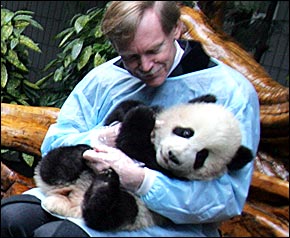
The Panda promises not to help with Iranian air defences.

Tuesday, January 24, 2006

Control Fraud

(to use Bill Black's phrase) Italian-style and US-style.

Phlegm and phlebotomy

The fight against global warming is lost, says the astrophysicist Paul Davies in his contribution to Edge's dangerous ideas for 2006. But in my view his analysis is unhelpful.

First, the idea that "the fight [to reduce emissions] is a hopeless one" risks being self-fulfilling. Yes, the forces against emissions reductions are absolutely huge, but we do not know for sure they are insuperable. As Dave Reay argues in his response to my note on James Lovelock's highly pessimistic assessment, we are not necessarily committed to the high emission scenario.

Second, saying "the obvious solution [is] nuclear energy" is like saying phlebotomy is the obvious solution to malaria. It applies antiquated and discredited thinking that further endangers the patient. Creating a more sustainable world industrial system means designing out dangers, wastes and legacy costs, not creating large new ones. (Some R&D into fission and fusion can continue in the eventuality that problems associated with these technologies are overcome, but not at the expense of an intelligent energy use revolution).

(On a side note, it appears that the British government, being either incapable or unwilling to learn, shares this mistaken view about nuclear power. It looks as if campaigners need to address this issue first.)

Third, Davies needs to substantiate his claim that "the evidence that the world will be worse off overall is flimsy", as it appears to go against the best judgement by climatologists and Earth systems scientists. Can an unstable world really afford - for example - millions of refugees from low lying parts of Bangladesh and the desertification of the Amazon Basin and so on in return for more power to Vladimir Putin's regional henchmen (assuming that Siberian tundra really did turn into good farmland)? Can one be sure that the positive feedbacks from unlimited emissions that so concern James Lovelock and others will not kick in and contribute to substantial net disbenefits?

For a wiser view see Martin Rees who says "The future will best be safeguarded - and science has the best chance of being applied optimally - through the efforts of people who are less fatalistic".

Sunday, January 22, 2006

The Wazirstan Beatitudes

You couldn't make it up when Osama bin Laden drives Rogue State up the Amazon bestseller list. But for a good read I would rather go to Kurt Vonnegut's A Many Without A Country.

Thanks, Kurt, for the reminder last week that it was Bomber Command that committed the largest single massacre in European history (135,000 in a single night at Dresden) and this week:

"For some reason, the most vocal Christians among us never mention the Beatitudes. But, often with tears in their eyes, they demand that the Ten Commandments be posted in public buildings...I haven't heard one of them demand that the Sermon on the Mount, the Beatitudes, be posted anywhere".

May I give you a hint, Kurt. Number Ten: "thou shalt not covet thy neighbour's house; ...[nor] thy neighbour's wife, nor his man-servant, nor his maid-servant, nor his ox, nor his ass".

Many of us have a really hard time not coveting our neighbour's maid-servant, nor his ox. Me especially. We need to be constantly reminded.

For a more serious thought on religious values in America see Charles Marsh on Wayward Christian Soldiers.

Gary Wills writes:
"There is now [in the US] an inverse proportion between religiosity and sincerity."

Wednesday, January 18, 2006

Imperial Grunts in Injun Country

"The suggestion that there is an analogy between the American Indian wars and the global role of the United States today is striking, and so is the comparison between those wars and the construction of the British Raj. In each case the resemblance is tenuous or nonexistent. The British presence in India involved many savage conflicts such as those surrounding the Indian Mutiny—which posed a serious threat to British rule in the mid-nineteenth century—and the Raj was always tainted by racism. Even so, throughout most of the colonial period a few thousand British officers were able to rule the continent without the large-scale use of military force. The primary goal of the Raj was to exploit India's resources, and so long as this process was uninterrupted the local population and its rulers were left largely to their own devices. In contrast, the goal of the American Indian wars was the expulsion of indigenous peoples from their lands, which in some cases resulted in the destruction of their way of life. Whether or not this can be described as genocide (as some have claimed) it was conquest of a different order from that imposed by the British on India". John Gray, in a critique of Robert Kaplan

All the grimmer in the light of increased role being required by the US of Nato (or a depleted coalition-of-the-willing part therefore: Brits but maybe not the Dutch) in SE Afghanistan. An analyst from Kings College, speaking on The World Tonight last night, was excessively diplomatic on the likely dangers of this development.

Launch of The Young Foundation

Last night I went to the launch of The Young Foundation. Short speeches from contributors to Porcupines in Winter included Richard Sennett on the importance of Michael Young's work on simply listening to ordinary people's understanding of their own lives, and Kate Gavron (co-author of The New East End, forthcoming) on the stories by which the old white working class live and the enduring importance for them - still - of the [Second World] War and the perceived golden age of the 1950s.

Philip Dodd, by contrast, warned against romanticising the idea of community (Dodd is a native of Grimethorpe, foverever associated in cliche with brassbands and mining). The very word was often used with a disciplinarian intent, or at least the wish of it, and idea that there were once happy communities could become endlessly regressive, he said. One should go back to Thomas Hardy's Return of the Native: "given a choice the poor will chose luxury over culture".

For all that, Alessandra Buonfino and Geoff Mulgan's essay, extracted in today's Guardian, still makes persuasive reading. For example," the austere solidarity of the war years - a time when, perhaps more than ever before or since, much of the population [in Britain] had felt useful, respected and engaged in a common project" cannot - as the authors say - be recaptured but it should be taken into account when facing the multiple future challenges of future "Britishness" (or "brutishness" as a mischievous letter pointed out was the spellcheck version of Gordon Brown's concept). The point is reinforced for me by the contrast with my girlfriend's home country of Spain, where the national narrative is so different.

I admire Geoff Mulgan's past work and trajectory (see for example here and here) and it looks like he has a great team. It was good, for example, to see at the launch two people I've worked with at different times and who hadn't previously met coming together for what could prove to be some really useful future work.

Tuesday, January 17, 2006

UK energy debate

The remark "we can easily deal with climate change without nuclear power" coming from the likes Kevin Anderson at the Tyndall Centre is useful. His stress on energy efficiency is bang on.

In my view, Madeleine Bunting was correct to say yesterday that the Labour government "has succeeded in doing very little other than reigniting an old (and many can reasonably argue, irrelevant) debate about the nuclear option".

Also, refer to comments from Tom Burke back on 30 Nov 2005.

Monday, January 16, 2006

Gaia, revenge and trust

In an article in today's Independent, James Lovelock says that it is too late to stop catastrophic changes to the global climate. The average temperature will rise by 8 degrees C in temperate regions and 5 degrees in the tropics. Billions of humans of beings will die as a result, he says.

Nevertheless, he says , it is not too late to take meaningful action (however unlikely that action may be): "I cannot see the US or the emerging economies of China and India cutting back in time [emphasis added], and they are the main source of emissions".

Is Lovelock suggesting that action to limit emissions could still limit temperature rises to significantly less than 5 to 8 degrees, or that without action to limit emissions now the rise will be even greater? What is the basis for his conclusion?

When I interviewed Lovelock at length in late 1999 for an article that appeared the following year in edition 21 of Green Futures, his predictions were no less dire than in today's article and in his new book (to be published in Feb 2006).

His thinking has not changed much, then. What has changed is that the science has progressed and has largely confirmed the most pessimistic scenarios of the late 90s. Also, the political situation looks to have deteriorated substantially.

My 1999 article concluded:

Much of what Lovelock has to say is decidedly grim. But there is a positive side to Gaia that he is particularly keen to emphasise. Of at least equal importance to [Gaia theory's] usefulness to science, he thinks, is the [moral] guidance it can offer.

"This has been occupying my attention probably more than anything else. People do need something to revere or worship, and religion is beginning to fade all over the world because it's failing to deliver in two fields. One: it used to be the source of information about life, the cosmos and everything - in other words it did science's job for it. And science now does that job so superbly well that religion has become almost redundant in that sphere. Two: it used to give moral guidance. And it's beginning to fail in that too...And so what do we do instead? Science offers nothing, or hasn't done so far, where moral guidance is concerned".

"But now it just happens, quite by accident and not by any conscious thought on my part or anybody else's, that Gaia does offer moral guidance. It does so because its rules are simple: any species that improves its environment favours the welfare of its progeny, whereas any species that adversely affects the environment dooms it for its progeny. And this is very moral. It gives us something to which we are accountable - the Earth itself".

Gaia, Lovelock stresses, is not and should never be the basis of a religion, because religions have faith. "The word I prefer to faith is trust. If we put trust in Gaia then it gives us something that will fulfil the same kinds of needs as religions have." And the problem is that industrial civilisation in its present form is profoundly betraying that trust.

"I'm a grandfather with eight grandchildren" [says Lovelock]. "I need to be optimistic. I see the world as a living organism of which we are part; not the owner, nor the tenant, nor even a passenger. To exploit such a world on the scale we do is as foolish as it would be to consider our brains supreme and...our other organs expendable. Would we mine our livers for nutrient for some short term benefit?"

Lovelock remains a superb thinker and communicator, whether or not he's right about nuclear power. His reflection in today's article on how Darwin would have responded to Gaia theory is convincing. And the analogy with a boat above Niagra falls (quoted in the accompanying piece by Michael McCarthy) is well chosen.

But it's not clear to me that he's right to talk about total catastrophe as inevitable. There appears to be an inconsistency between on the one hand
saying it's too late, and on the other hand refering to changes in future emissions trajectories that could be undertaken in time (however unlikely that change may seem at present).

Sunday, January 15, 2006

Back from Zambia and Malawi

While I was away these appeared on openDemocracy: The metamorphosis of big oil?
and a contribution to the predictions for 2006 (sorry for my spelling mistakes and other glitches!)

I didn't find an actual prediction in Gopal Balakhrishnan's contribution , but I liked the quote from Guy Debord:


Cretinisation, so advantageous to rulers, owners and rentiers, nonetheless comes at a price for would-be empire builders:"Once the running of the state involves a permanent and massive shortage of historical knowledge, the state can no longer be led strategically."

It's also worth considering whether Slavoj Zizek is right when he says:

This...is what awaits us in 2006 and, one must say, beyond: the struggle between a spurious "culture of life" (the way Christians formulate their refusal of the very core of human creativity) and [an Islamist] "culture of death," both of which must be rejected in the name of any truly emancipatory politics.

Saturday, December 24, 2005

Hello?

"The minister also revealed that the Israeli army might now begin to fire shells at populated areas of Gaza in response to an attack by rockets." (Israel plans Gaza 'aerial siege')

Thursday, December 22, 2005

Turning point

Walking to the bakery early this morning, I watched a yellow sun edge very slowly over the rooftops. It felt like the moment when the world turns. The Earth has reached the furthest point of its annual wobble and now starts to tilt the other way. Much of the northern winter is still ahead, but there will be ever more light.

May the coming months bring more awareness of the wonders of existence, from creatures like this spotted cuscus to the mind blowing potential of quantum computation in a universe that may be just one among
10500.

This blog will pretty much shut down until mid January (see travel plans here).

Wednesday, December 21, 2005

Sleepwalking

"For Mr Ahmadi-Nejad and his allies, it is their experience in the [1980-88 war with Iraq] with that defines their strategic outlook. Iraq’s indiscriminate use of chemical weapons against Iranian civilians and combatants has scarred the returning war veterans, making them suspicious of the motives of the international community that was largely indifferent to Iran’s plight.

...In the coming months, diplomats will debate and international organisations will issue their periodic rebukes and contemplate their sanctions. And, all along, Iran will inexorably edge closer to the nuclear threshold"

- Ray Takeyh: Diplomacy will not end Iran’s nuclear programme.

Tuesday, December 20, 2005

The sceptical climatologist

"The scepticism that I advocate amounts only to this: (1) that when the experts are agreed, the opposite opinion cannot be held to be certain; (2) that when they are not agreed, no opinion can be regarded as certain by a non-expert; and (3) that when they all hold that no sufficient grounds for a positive opinion exist, the ordinary man would do well to suspend his judgment."

Betrand Russell quoted by Gavin Schmidt in How to be a real sceptic, a useful piece that's been needed for a while.

Monday, December 19, 2005

Voice of reason on ANWR

You know it makes sense (brought to you by the NAM). See also here.

Threefold tears

"Tears have three separate components. The innermost tear layer coats the surface of the cornea and is called the mucous layer, or mucin. The middle tear layer is an aqueous [coating] produced by the lachyrmal glands and supplies salt, proteins and other compounds to the cornea. The outer tear layer is composed of oil from the meibomian sebaceous glands in the eyelids. This helps to prevent evaporation of the watery tears from the surface of the eyes".

Joh Uys of Bellville, South Africa quoted in Does Anything Eat Wasps? (page 23)

King Yoweri's ghost

A finding against Uganda for plunder of Congo assets by the International Court (see here) is another body blow to the supposed legitimacy of Yoweri Museveni, who - along with Meles Zenawi - was supposed to be a pillar of the UK government's commission for Africa.

Prudence

Barnaby Philip's third film for Newsnight (search "Prudence Radebe" audio video results on the Newsnight web site) on the struggle to get access to anti-retrovirals in South Africa (broadcast on 19 Dec) is an excellent piece of work. A useful note ahead of our forthcoming trip to Zambia.

Only about 85,000 out of South Africa's approximately five million HIV positive people can get the ARVs, which cost about £15 per person (not cheap, but affordable for a middle income country like RSA, even if you don't take into account the enormous benefits to the economy of bringing very large numbers of adults of working age back into the economically active population).

(another demonstration, as if it were needed that John le Carre and his film making successors, for all theirstory-telling skills, chose the wrong moment with The Constant Gardener. Big pharma is no longer the big villain, in this case at least) .

Evo el ganador

"Esta incorporación de sectores indígenas en el poder no había ocurrido en los 200 años de vida republicana y esto es un elemento de inflexión muy importante para el país" (Morales se decalara ganador).

Saturday, December 17, 2005

Max Eastley on nature

"We sometimes think of nature as being slow, but we're missing it all the time. It's very, very fast" - Max Eastley (here and here).

Friday, December 16, 2005

Theater of empty talk

Paul Theroux being bilious, but not necessarily altogether wrong. He does leave out an important part of the puzzle by downplaying the deep impact of colonialism, whether in Ireland or Malawi, and the consequences that take so long to overcome (in Ireland's case successfully).

The big thing

Philip Roth being gloomy. Robert Winston being reasonable.

Wednesday, December 14, 2005

Wise rat, foolish human

"The experts’ trouble in [Philip] Tetlock’s study is exactly the trouble that all human beings have: we fall in love with our hunches, and we really, really hate to be wrong. Tetlock describes an experiment that he witnessed thirty years ago in a Yale classroom. A rat was put in a T-shaped maze. Food was placed in either the right or the left transept of the T in a random sequence such that, over the long run, the food was on the left sixty per cent of the time and on the right forty per cent. Neither the students nor (needless to say) the rat was told these frequencies. The students were asked to predict on which side of the T the food would appear each time. The rat eventually figured out that the food was on the left side more often than the right, and it therefore nearly always went to the left, scoring roughly sixty per cent—D, but a passing grade. The students looked for patterns of left-right placement, and ended up scoring only fifty-two per cent, an F. The rat, having no reputation to begin with, was not embarrassed about being wrong two out of every five tries. But Yale students, who do have reputations, searched for a hidden order in the sequence. They couldn’t deal with forty-per-cent error, so they ended up with almost fifty-per-cent error".

Louis Menand: Everybody's an Expert , a review of Tetlock's Expert Political Judgement: How Good Is It? How Can We Know? (New Yorker, 5 Dec), which should be read in full.

Tuesday, December 13, 2005

Balance

"The idea seems to be that we go out to report but when it comes time to write we turn our brains off and repeat the spin from both sides. God forbid we should...attempt to fairly assess what we see with our own eyes. 'Balanced' is not fair, it's just an easy way of avoiding real reporting and shirking our responsibility to inform readers".

Ken Silverstein of the Los Angeles Times quoted by Michael Massing in The Press: The Enemy Within.

(see also The False Objectivity of Balance, which I was glad to quote in public discussion at IMES)

Monday, December 12, 2005

Cui bono...

...the assassination of Gibran Tueni?

A tree of light

This afternoon in the University Park, Oxford

"Present at the disintegration"

"optimism is misguided, for none of the problems associated with Iraq's monumental change have been sorted out. Worse, profound tensions and contradictions have been enshrined in the Constitution of the new Iraq, and they threaten the very existence of the state".

Kanan Makiya, 11 Dec

Sunday, December 11, 2005

Iraqi liberation?

The press release issued today Oxford Research Group's report of this title contains a call, among other things, for “build[ing] legitimacy in the Iraqi political process” post election by:

Reach[ing] agreement among the communities on key constitutional provisions, in particular on the equitable distribution of future oil reserves, and establish a genuinely inclusive political process enabling a negotiated end to the nationalist insurgency.

But if the analysis in Crude Designs from Platform et al is correct then something that will appear to Iraqi eyes to be the equitable allocation of future oil revenues may prove especially hard. According to this study, at least 64% of the country's oil reserves have already been allocated for development by multinational (US and British) oil companies.

(see also The Washington Post's Iraq and Consequences: six specialists say what to expect if U.S. forces leave or stay in Iraq, and It takes a Potemkin village from Frank Rich in the NYT.)

"A more recognisable, muddled human being"

Richard Mabey.

Flush

I have found Carl Hiassen's recent books to be same-y, but on the evidence of Frank Cottrell Boyce's review, Flush looks worthwhile.

"The single worst idea in history"

What do you think is the single worst idea in history?

Without question, ethical monotheism. The idea of one true god. The idea that our life and ethical conduct on earth determines how we will go in the next world. This has been responsible for most of the wars and bigotry in history.

But religion has also been responsible for investing countless lives with meaning and inner richness.

I lead a perfectly healthy, satisfactory life without being religious. And I think more people should try it.

(from What's the big idea?, an interview with Peter Watson)

Friday, December 09, 2005

Zivilcourage

Isabel Hilton’s interview for openDemocracy with Daniel Ellsberg who leaked the Pentagon papers (published 7 Dec) contains much that is interesting. I guess few people will listen to it as it takes the best part of an hour to do so. Further, the blurb on the web site undersells the content of the interview, and is carelessly written (for example, in the second quote the words “to be killed” are omitted after “any number of Americans”). A well cut and restructured transcript might attract more of the attention this exchange deserves. Here are quick comments:

  • The remark that Robert McNamara knows nothing about politics is amusing but not completely plausible. Ellsberg sniping at McNamara’s place in the sun in The Fog of War. More to the point in the current circumstances, President Johnson’s careful calculations as to the domestic political balance look different from the behaviour of the present Executive. “[President Bush] is more determined that ever to say the course…He doesn’t feel any pain. Bush is a believer in the adage 'People may suffer and die, but the Church advances' ”, Seymour Hersh reports a senior defence official as saying (Up in the Air, New Yorker, cover date 5 Dec).
  • Six hundred million dead in Russia, China and Eastern Europe as a result of nuclear attack in the early 1960s would have been quite a party. Ellsberg does not mention the likely level of casualties in the US, although his reference to the Russian determination to totally anihilate Germany in the event of war is notable. His comments make a useful complement to McNamara’s ninety million or so American deaths – a price which (according to McNamara) Fidel Castro would have been glad to inflict along with the eradication of his own country in 1961 just to make a point.
  • The proposition that the US does not plan to get out of Iraq until the oil runs out – forty or years or more – may be about right. James Fallows was prescient to describe it as The Fifty-first State. But can it "work"? If Hersh is right, then plans to maintain control by US air power in support of a friendly Iraqi government’s ground forces could run into severe problems.
  • Philip Giraldi’s assertion in The American Conservative that Dick Cheney has ordered plans for a full scale air attack on Iran to be ready by June [05, presumably] would seem to accord with what I heard in Washington on 4 Nov 04 (see my 12 Nov 04 post War Gaming Iran in Grains of Sand Nov 04 archive). Among the notable things Ellsberg says here: “There probably is not one general or full colonel in the Pentagon who wants war with Iran. They are appalled but they are doing the plan, which is always the case”.
  • Ellsberg’s two key recommendations for averting an attack on Iran, which he considers extremely likely (if by the US only to avert the Israelis doing it first), should be more widely circulated and discussed. The first is that just a small handful of insiders need to leak key papers now in acts of Zivilcourage. The second is for European countries to put their airspace and air bases off limits for US forces preparing for and executing the attack. This doesn’t look likely at present. But if it is to happen then civil society groups in Europe need to start organising now, not a few months hence when it is likely to be too late.

Wednesday, December 07, 2005

Lunch with Tariq Ramadan

Coming a little dazed off the plane from Singapore, I attended a lunchtime talk at Oxfam's headquarters with Tariq Ramadan. (Oxfam is increasingly working with Muslim NGOs of the kind described here by Ehsan Masood).

Ramadan said true respect meant being ready to pay attention to the full complexity of "the other" - and specifically the complexity of different Muslim interpretations and experiences as they are now playing out in Europe. This needed to be acknowledged by all of us alongside other European experiences, be they Christian, Jewish or indeed Buddhist.

He said there was a danger of a rising idiology of fear. He warned against the dangers of a victim mentality. He called for more education across European societies of the different memories and traditions of more recently established communities. And he stressed the importance of a critical mind.

He said much more that was all well and good, and -
given the perilous times we live in - worth repeating however platitudinous much of it may seem. (For something a little more challenging, see John Vinocur on The US model for Europe: Immigrant work ethic, NYT 5 Dec.)

But in my view Ramadan said at least one thing that was not all well and good. For Ramadan "Islam is not a culture"; it is a fundamental which is mediated through various cultural forms.

I put it to him that for people who define themselves as secular, Islam - like other religions - is, precisely, a product of historical contigency and culture. Where, I asked, would he put in his mental model the experience of those from a Muslim background who self-define as secular - as do, for example, some Brits of Pakistani ancestry that I know?

Ramadan's answer bore no relation to my question. (He talked of the importance of distinguishing cultural practices in some Muslim communities that are against women's rights from the true Islam).

My interim hunch is that Ramadan avoided the question because even to acknowledge it opens a crack in the foundation of his world view. He calls for universal recognition of the complexity of the experience of the other but - from the evidence of this encounter at least - dodges the most important developments in Europe over the last five hundred years or so from Copernicus through Voltaire, Kant and beyond: the move beyond reliance on revelation from spirits, gods and magical thinking to the exercise of reason (notwithstanding the catastrophes that result when reason is abused).

I'd be glad of further discussion.

And I wish Tariq Ramadan well and am open to honest and respectful encounters.

Tuesday, December 06, 2005

A viverrid?

After three days deep in rainforest on the Malaysian side of the central highlands of Borneo, I am now in transit in Singapore airport en route to London.

In Batang Ai national park I was one of the guests of WWF Malaysia and Sarawak Forestry. The chief technical officer for WWF's Borneo Programme alerted us to news that appears
here on the sighting of what may be a new species of mammal. The timing is fortuitous for WWF's campaign for a huge transboundary "Heart of Borneo" reserve.

The day before yesterday I was hiking high on a precipitous ridge in the forest not too far from where the discovery was made. A Mexican colleague and I were with biologists and local assistants surveying wild orang utans. We didn't see any of our primate brethren, but did count seventeen of their "nests" high in the canopy.

The local Iban people do not kill orang utans because they believe them to be descendents of their ancestors. This is, of course, literally true in a scientific sense.

We did see a tiny, very fast-moving squirrel that resembles our much more remote ancestors. Later when traveling upriver we saw two large eagle owls, and beautiful frogs in the rushing cascade of fast water over smooth ancient stone.

Wednesday, November 16, 2005

Travel plans

to Poland, Indonesia and Malaysia noted here.

Willie Pete

The scandal of the use of white phosphorus against people by the US military in Iraq has been brewing for some time. It has reached the British mainstream media over the last week or so including, yesterday, a column by George Monbiot (see footnotes here for references). A couple of quick points:

  • The use of such a weapon in such a way is appaling (if not exactly suprising). Also, it is likely to prove to be "worse than a crime: ... a mistake". In that regard it is entirely consistent with other actions and tactics by the US-led coalition (not to mention torture being used by the Iraqi government etc).
  • It ill serves the Iraqi people, or anyone else, to use the issue to make misleading comparisons. Making an equation between the coalition governments and US-led forces on the one hand and the government of Saddam Hussein on the other is gross. We need more sophisticated critiques.

Nicely done

They cannot come to you, so you must go to them, trekking ever southward. The cold is unrelenting. Most days the sun barely makes an appearance: at midday the contours of the coast are shrouded in a dismal, leaden twilight, while curtains of icy rain undulate across the bay. When I finally arrive, it feels like I've reached the edge of the world. This is Torquay, surely one of the most inhospitable places on the planet.

Tuesday, November 15, 2005

What they're doing with the money

On 17 August I asked how oil exporters would spend the windfalls from high oil prices. Two recent articles seem to shed a bit of light on the issues.

Recycling the petro dollars, a fascinating piece in The Economist (Nov 10), reports that "most of the extra money is being saved, not spent".

And from Russia, the second biggest exporter after Saudi, Andrew Kramer reports for the New York Times that there is considerable caution about the use of the money (Awash in Petrodollars, Russia Frets About the Paradoxes of Bounty), with the government continuing to commit to the Stabilization Fund and large foreign debt payments.

Social spending is reported to be more limited: $4bn for "doctors' salaries and other social spending" in 2007 is the only figure stated in the article.


In view of the daunting scale and depth of Russia's social, health and educational challenges this seems like very little.

(Oil exporters will receive earn around $700bn this year)

Monday, November 14, 2005

Under Western eyes

There are some quite sane comments in a report of a conference held a couple of months ago as part of Princeton's project on US "National Security in the 21st Century" (and recently published on the web) .

On "Europe", for example, there were two schools of thought: pessmists and optimists.

"[The pessimists] argue that Europe will be less able and less willing to fulfill its historic role as America's key ally, pointing to a declining and aging population, a low tolerance for immigration, deeply embedded resistance to necessary root and branch reform, slow economic growth, political stagnation, and a refusal to seriously engage in defence modernization. Their bottom line is that while the U.S. should seek good and fruitful relations with Europe, it should not kid itself that [Europe] can ever again be the robust and loyal partner that it once was.

The optimists argue that prophecies of Europe's decline are greatly overstated....Europe has a) over 100,000 troops overseas, b) supported every U.S. military actitivity since the end of the Cold War except Iraq, c) complements the U.S. in important ways, d) exercises considerable soft power, e) expanded and continues to expand the zone of democracy eastwards, f) is a pioneer of international aid, and g) has a compelling social model that appeals to large parts of the world."

As the report almost says, the reality may be a mix of both (plus some things it doesn't mention).

Recent events in France would seem to add to the pessimist's case. But France is not all of Europe. Some of those among the most critical of the state of France, such as Nicola Bavarez, author of La France qui tombe, emphatically distinguish it from other countries. See: Why a sick France needs a true cultural revolution. Is he right?

"The greatest sea change"

Quantum computation.

Friday, November 11, 2005

One last job for Nelson Mandela?

In Quisling and Occupier, Virginia Tilley recommends giving up on the two state solution for Israel and Palestine and pursuing a unitary state with justice for all.

"From the Jewish-Israeli side, Israel would have to be reimagined and reconstructed in the only stable formula ever truly available to Zionism: a democratic state embracing both Jewish and Palestinian national homes within an overarching civic nationalism...

From the Palestinian side...The Israeli government would no longer be seen as the unjust alien occupier of Palestinian land but as an unjust apartheid government in a unified land."

Expecting such fundamental ideological shifts still seems hopelessly utopian to many people, says Tilley. Yes, but if it's the right path how about a big push to reframe the challenge, led (at least symbolically) by the likes of a global hero like Mandela along with a notable - and conspicuously peaceful - figure from a Muslim tradition (e.g. Shirin Ebadi)?

I guess this would never fly, for a million and one reasons?

(Tilley's piece was published together with Sara Roy's 'A Dubai on the Mediterranean')

Dave Reay review

My review of Climate Change Begins at Home is here.

Dave Reay writes to say to correct my comment that there is nothing in the book on carbon offset. It is indexed under "Trees: planting to offset emissions..." And here's the relevant passage:

"It's unrealistic to think that all our air travel emissions can simply be offset by planting trees. The primary worth of such schemes is to get people thinking about their climate impact, rather than to solve it. Some schemes - such as 'Climate Care' for example - now allow you to offset your emissions not with trees but with funding renewable energy schemes in the developing world. The climate benefits of doing this may be more transparent, but there's no easy way round this. To minimise your contribution to global warming fly less, or not at all".

This is OK, but it should be emphasized that :

  • the case for tree planting is, at best, weak. There may be many good reasons to plant trees in some circumstances, but carbon sequestration is unlikely to be one of them.
  • funding energy efficiency may very often be a better priority than renewables (Climate Care's compact flourescents for South Africa townships being a case in point)

I would therefore suggest that a future edition of the book discuss offset in more detail.

As for flying less: yes, objectively this makes sense. It does, however, bring one to a big question not addressed in my review. That is, the willingness - or otherwise - of most relatively wealthy people (the richest one billion) to consume less.

Hair shirts don't go down well, as Jonathon Porritt almost put it. And a writer at The Economist was on to something when he or she observed observing that you need to appeal to people's self-interest because that tends to trump tight-fistedness (see
Virtue for Sale).

It's a tough challenge to influence attitudes, market products and promote behaviours that are less environmentally destructive. It may require a careful mix of greed and fear (...and wanting to do the right thing, of course!). And even the most ambitious initiatives concieved hitherto may be hopelessly inadequate with regard to the objective challenges.

So, for example more thing on flying: booming air travel in Asia will easily wipe out even the most spectacular gains in passenger kilometre efficiency in the richest countries thought to be vaguely credible (see the post Air apparent from July).

Wednesday, November 09, 2005

Back to the 14th century, Toto


Darwinism is only a theory! The Kansas board of education has rewritten the definition of science so that it is no longer limited to the search for natural explanations of phenomena.

In Pennsylvania, a different scenario.

Schmabeas corpus

Gordon Brown flies to Israel for "vital" meetings with Israeli and Palestinian politicians. As soon as he lands he gets on the phone to cancel the meetings, and flies back to the UK after barely two hours on the ground to help the the Prime Minister fight for a bill that would allow the police to hold terrorist suspects for 90 days without charge.

Explanation 1. GB genuinely believes that it is a good idea to hold people for 90 days without charge. Habeas corpus, schmabeas corpus.

Explanation 2. GB maneouvering to be cast as "saviour" of Labour party in time of crisis

Explanation 3. ?

Tuesday, November 08, 2005

Iraqi humour

The brothers told me a joke about the occuption. An American soldier is about to kill a Shiite, who cries, "Please, no, in the name of Imam Hussein!" The American asks who Imam Hussein was and then decides to spare the man's life. A few weeks later, this same soldier is sent to Falluja, where he's cornered by a Sunni insurgent. The soldier thinks fast and cries, "Please, no, in the name of Immam Hussein!" The insurgent says, "What, You're an Americn and a Shiite?" and blows him away.

There was a moment of laughter in the room.

I had been collecting Iraqi jokes, and I weighed telling the Shaker brothers one. There was a joke about the newlyweds in Falluja (Falluja jokes abounded in Iraq). The man asks his new bride to suck his dick. "No, no," she says, "it's haram." "We're married now," he says, "please, please do it." "I can't, it's haram". "Please." "Okay, if you cover it in honey." "Are you kidding?" If I cover it in honey, I'm sucking it".

A glance at the faces of somber Ali and devout Shamir made me file the Falluja joke away.

Then there was the joke I'd recently heard, from an Iraqi Shiite, about Ayatollah Mohamed Baqr al-Hakim, the spiritual leader of the Tehran-based Shiite political party, who had been killed by a car bomb in Najaf in August 2003. In the joke, he is blown into so many pieces that his body can't be identified. Finally, investigators bring a severed penis to his widow and apologetically ask her whether she can make a positive identification. The widow glances at the object and says, "That's not my husband. That's his driver."

This joke was so haram that I felt a quiver of fear just thinking about it.

Finally I remembered a repeatable joke. Ten Kurds locked up in a mental hospital spend six months fighting one another to look through the tiny hole in the wall of their cell. A doctor, curious, enters the cell and asks to have a look. He puts his eye to the hole for ten minutes: nothing. "There's nothing there," he says. One of the patients answers, "We haven't seen anything in six months - you expect to see something in ten minutes?" But by the time I remembered the Kurdish joke, the moment had passed.

From George Packer's The Assassins' Gate (page 266)

"The victory of fear over hope"

"Most if not all of Europe is - or should be - concerned by events in France", says Dominique Moisi.

Olives and coral reefs

My first plan for this month had been to help with the olive harvest in the West Bank, as documented here.

Instead, I am embarking on a couple of other projects. One of them - an investigation into whether tropical coral reefs may be the first ecosystem to be eliminated by climate change - is noted here.

It's hard to know what the right choice is, or would have been. Perhaps there is no such thing.

Monday, November 07, 2005

Bimark bismillah

"Realists ...refuse to don rose-colored glasses when considering the United States itself. As a consequence, they understand that 'American exceptionalism' is a snare. Realists reject claims of American innocence - the conviction, as [Reinhold] Niebuhr wrote..., that 'our society is so essentially virtuous that only malice could prompt criticism of our actions.'

The United States emerged as the world's sole superpower not due to its superior virtue but because it prevailed in a bloody century-long competition. Among the principal combatants in that contest were three genuinely odious criminal enterprises: the Third Reich, the Soviet Union, and Mao's China. The United States came out on top because it allied itself with Stalin against Hitler and subsequently made common cause with Mao against Stalin's successors. These were not the actions of an innocent nation".

So writes Andrew Bacevich in a relatively clear-eyed piece. Nevertheless, he still appears to believe in a form of American exceptionalism (or deploys a seeming belief in it for rhetorical purposes) when he writes of a "distinctively American realist tradition" (unlike those oh so dastardly, moustache-twirling Europeans).

Another assumption here is that modern nation states retain most of the characteristics of their nineteenth and twentieth century predecessors.

Sunday, November 06, 2005

The bush where Man was

An account on BBC online of the row over the use of the word "genocide" with regard to the San who used to live in what is now called the Central Kalahari Game Reserve is, perhaps, a little too cautious.

While it's obviously true that the Bushmen are far fewer in number than those who died in Darfur (not to speak of some of the more notable episodes in the twentieth century), they may - and this is a slightly strange notion to grapple with - have a value in disproportion to mere numbers because of their extraordinary place in the history of the humanity (that is, as representatives of one of its oldest and most continuous strains).

That being said, Ditshwanelo's warning on the possible danger of inflammatory language must be taken seriously - given their far greater knowledge than many of us outsiders.

Friday, November 04, 2005

Positive feedback

"Biologist Karl von Frisch had it more or less right when, confronted with the variety of delicately patterned radiolarans and diatoms, he was determined not to get misty-eyed: 'I do not want to wax philosophical about so much useless beauty scattered over the oceans', he said. 'Nature is prodigal ' ". - Philip Ball: Natural Talent, on creativity in nature

Thursday, November 03, 2005

Wham bam thankyou ma'am!

I am shocked by a report that the number of miscarriages in Gaza hospitals is reported to have increased by 40% because of repeated very loud sonic booms from low flying Israeli aircraft.

Clearly, if the rate of miscarriage has only increased by 40%, the security forces need to double and redouble their efforts again.

Pressure must be increased so that those who harbour terrorists are brought into line, and the population levels are set on a more sustainable course.

Europe in big trouble

"Radical Islamism is as much a product of modernization and globalization as it is a religious phenomenon...This means that "fixing" the Middle East by bringing modernization and democracy to countries like Egypt and Saudi Arabia will not solve the terrorism problem, but may in the short run make the problem worse. Democracy and modernization in the Muslim world are desirable for their own sake, but we will continue to have a big problem with terrorism in Europe regardless of what happens there".

Francis Fukuyama: A Year of Living Dangerously. An interesting piece, but when considering the alienation that leads to trouble in Europe there is no mention of conditions in France, despite the week of riots in Paris

Wednesday, November 02, 2005

Black sites

CIA Holds Terror Suspects in Secret Prisons

The CIA has been hiding and interrogating some of its most important al Qaeda captives at a Soviet-era compound in Eastern Europe, according to U.S. and foreign officials familiar with the arrangement. (continues)

Useful blasphemy

An elegant introduction by Ian McEwan to What We Believe But Cannot Prove.

Among the notable quotes is Stanislas Dehaene, of the Institut National de la Santé in Paris: "We vastly underestimate the differences that set the human brain apart from the brains of other primates".

Tuesday, November 01, 2005

Parapets and trenches there

"I came across a Cornishman who was ripped from shoulder to waist with shrapnel, his stomach on the ground beside him. A bullet wound is clean - shrapnel tears you all to pieces. As I got to him he said, 'Shoot me.' Before I could draw my revolver, he died... He gasped one word - 'Mother'. That one word has run through my brain for 88 years. I will never forget it". Harry Patch, aged 107

Windows for hope

"Every year a million kids die [of malaria]...You could save between thirty and fifty per cent of them with [bed] nets alone [costing approx $4 each]. If you added improved hospital services and proper medicine [for a few dollars more], you could save eighty percent. But we already know how much eight hundred thousand African children are worth to the rich world. We have known it for a long time".

Stephen Magesa, an entomologist at Tanazania's National Institute for Medical Research, quoted in Michael Specter's valuable report on the Gates Foundation and malaria (New Yorker, 24 Oct) - and a bit of extra context for latest reports of what could be important grants from the Foundation.