Musah Muhammad lives between the dump and the stagnant lagoon. His is unequivocally the worst bit of land in Sodom and Gomorrah, a freshly reclaimed patch of silt and trash. It would likely be one of the first cleared once the dredging starts, so people keep treating it like an open-air toilet. There is a crust of fat, iridescent blowflies on every single surface.from The Bridge to Sodom and Gomorrah by Yepoka Yeebo
Musah spent months sleeping out in the open on the dump, under the two diggers abandoned during the last attempt to dredge the lagoon. He was once attacked by packs of rats as he slept, and another time woke up to find himself lying next to corpses that had floated to the surface of the water. Everybody said he’d get killed, but he survived.
Friday, March 18, 2016
The worst bit of land in Sodom and Gomorrah


Tuesday, December 22, 2015
Books of 2015

Much but not all of what I read this year was work-related. My recommendations are:
Owning the Earth by Andro LinklaterI didn’t see nearly as many films as I would have liked to. Among those I did see that I particularly liked were Timbuktu and Song of the Sea.
Cosmigraphics by Michael Benson
The Vital Question by Nick Lane
Clade by James Bradley
Adventures in Human Being by Gavin Francis
Just Mercy by Bryan Stevenson
Aurora by Kim Stanley Robinson
Braiding Sweetgrass by Robin Wall Kimmerer
The Wonderful O by James Thurber
I’ve just finished Number 11 by Jonathan Coe, and am reading Rise of The Robots by Martin Ford and After Nature by Jedediah Purdy.
Among the books I hope to read next are Inequality by Anthony Atkinson and Empire of Cotton by Sven Beckert.
Image: in July I got to leave my shed and spend a week in another shed. But it was a shed on Eigg with a view of Rùm.
Tuesday, December 01, 2015
'A democratic Anthropocene'
...There’s an ethnography of Alaska’s Athabascan peoples, by Richard Nelson, called Make Prayers to the Raven. Its gist is that these “animist” folks don’t revere an abstract Nature, nor do they see it as just a set of resources and logistical problems. They have relations to it, rather like the relations you might have with your partner’s family, or the neighbors, or your co-workers: a bit opaque, touchy, a mix of affection, obligation, and prudence. And these relations are specific—not with Nature, but with the salmon, or a river, or a tree. They are on many scales, again, much like our relations with individuals, institutions, countries, cultures, in our human-on-human lives.
We can’t decide to be Athabascan, of course, but this strikes me as a promising direction for a realistic, open-minded ethical practice. It takes very seriously that we live with the rest of the world, and it can be a big pain in the ass, or even hurt or kill us, but it is also the only possible site and source of all the joys we can have...
...In some respects, Anthropocene thinking is ecological thinking turned up to eleven, with a keen awareness not just of the practical relations among human and natural systems, but also of the values at stake in those.
What I call a democratic Anthropocene is a way of naming the politics that could possibly be up to this situation. It’s about building movements and institutions that move toward an equal voice in shaping the planet. And it’s about building up the capacity to begin engaging in real collective self-constraint...Jedidiah Purdy interviewed by Ross Andersen.
This goes a lot further and deeper than my ramble, Growing up in the Anthropocene
Saturday, July 25, 2015
Embryon philosophers

I have review essay on Alberto Manguel's Curiosity in The Guardian today. Here are some further notes.
as children... Recalling a childhood very different from Kulka's, Annie Dillard writes
Everywhere, things snagged me. The visible world turned me curious to books; the books propelled me reeling back to the real world.crows These observations on Caledonian crows and children come via Alison Gopnik. For more on the cognitive abilities of crows see, e.g., Crows Understand Analogies.
the nature of desire what can one sensibly add on this most contemplated topic? Samuel Johnson wrote: “the mind of man is never satisfied with the objects immediately before it.” In Religion of the Future, Roberto Unger writes:
Our insatiability is rooted in our natural constitution. Human desires are indeterminate. They fail to exhibit the targeted and scripted quality of desire among other animals.Even when, as in addiction and obsession, they fix on particular objects, we make those particular objects serve as proxies for longings to which they have loose or arbitrary relation
... It is not only to other people that we are ambivalent; it is also to our own desires because they are ours and not ours. This confusion enters into the experience of insatiability and endows it with its tortured and desperate quality,endless distraction...an obesity of the mind from here
new spaces new spaces for poetry. The unedited text continued:
A bacterium found on the rear end of a small worm in the deep ocean hints at the origin of complex (eukaryotic) life. A telescope rivalling the great pyramids in size that is soon to be built in Chile will enable its creators to make sharp images of earth-like planets far away in the galaxy. Optogenetics and recently developed imaging techniques have enormous potential to increase understanding of the human brain, the most complex thing in the universe, and the treatment of disease. [1]My response to that is: good for him. The pre-edited text continued:
We are but embryon philosophers. The great flood-gates of the wonder-world swing open and reveal a wild what. [2]
Notes:
[1] The bacterium on the rear end of small worm deep in the ocean is Parakaryon myojinensis. See The Vital Question by Nick Lane. The telescope rivalling the great pyramids in size is the European Extremely Large Telescope. Its images will be 19 times sharper than those from the Hubble Space telescope and, it is claimed, able to show Earth-like planets in distant space. See also this article about telescopes of the 2030s. On recently developed [brain] imaging techniques see, for example, this article on optogenetics.
[2] embryon philosophers is from Thomas Browne. The great flood-gates of the wonder-world swing open is from Herman Melville. The wild what is from Amy Leach.
Tuesday, April 21, 2015
"They want the forest to be happy"
Q. What aspects of the music did not prompt a universal response?
A. We looked at whether the music evoked happy/joyful or sad/scary feelings, and got a positive/negative rating. We used music from three films: the melancholy theme from Schindler's List, the scary shower scene from Psycho and the upbeat Cantina scene tune from Star Wars. The Canadians reacted as you might expect. The Mbenzélé...found all the music negative.
Q. Why might the Mbenzélé not like the Western music?
A. All the pygmies' own music is highly arousing and positive. They feel negative emotions disrupt the harmony of the forest and they depend on the forest and so they want it to be happy.from an interview with Stephen McAdams regarding his research into universals in music.
Mbenzélé music is mostly vocal, McAdams explains, with some clapping and beating on log drums. But is "of a sophistication comparable to Western symphonic music, with extraordinary polyphonies and polyrhythms."
For the Mbenzélé, music is functional. "They don't sit around and consume it. Music accompanies various kinds of activities."
I wrote briefly about the music of Mbenzélé (Babenzele) on page 128 of The Book of Barely Imagined Beings.
Saturday, February 07, 2015
Norm enforcement
For rebellious behaviour, slaves are pinned to the ground, and burned by degrees from the feet and hands, burning them gradually up to the head, whereby their pains are extravagant...For crimes of a lesser nature Gelding [castration], or chopping off half of the foot with an Ax...For Negligence, they are whipt by the overseer with Lance-wood Switches, till they be bloody, and several of the Switches broken, being first tied up b the hands in the Mill-Houses...After they are whip'd till they are Raw, some put on their Skins Pepper and Salt to make them smart; at other times their Masters will drop Melted Wax on their skins and use several exquisite tortures.from an 1698 account by Sir Hans Sloane about practices on sugar plantations in the West Indies, quoted by Andro Linklater in Owning the Earth (2013).
Slaves or sage slaves by Jerry Toner is insightful on the Roman institution of slavery, with only mild teases.
Friday, February 06, 2015
The Singular Universe

Here are a few additional notes and comments relating to a review of The Singular Universe and the Reality of Time published in The Guardian.
the distinction between past, present and future is only an illusion Health warning: cosmologists are not saying it is OK for you to be late. See, e.g., Sean Carroll. See also The Now.
[added 16 February]: Time Reborn there is a fascinating critique of Time Reborn by Joe Boswell here
physicists in the academy groan Smolin is based at the Perimeter Institute outside the academic system. The quality of its people can be gauged in the commitment of its director Neil Turok to, e.g., education in Africa.
deep freedom openDemocracy published an edited extract from Roberto Unger's Religion of the Future here. See also his site and talks.
prophet – or...crank Jeremy David Bendik-Keymer writes "Unger may think of his work as preparation for prophesy, but it ends up as pontification."
some essential points can be readily grasped Lee Smolin has written a handy summary of key ideas for New Scientist. Roberto Unger outlines some in audio with A universe in which everything changes sooner or later.
It appears there will be some errors in the print version of my review. For example, cosmic inflation is thought to have begun 10-37 seconds after the big bang, not 10-37. Also, I think it is correct to say that Unger and Smolin are only saying that parts of this model are preposterous, not necessarily all of it.
For A New Map of Wonders I have blogged in connection with Unger here and Smolin here.
Bryan Appleyard reviewed The Singular Universe here (paywall)
Finally, Rilke's ninth Duino elegy has this:
Once for each thing. Just once; no more. And we too
just once. And never again. But to have been
this once, completely, even if only once:
to have been at one with the earth, seems beyond undoing
Image from The Landreader by Dominick Tyler
Monday, January 12, 2015
On Blake
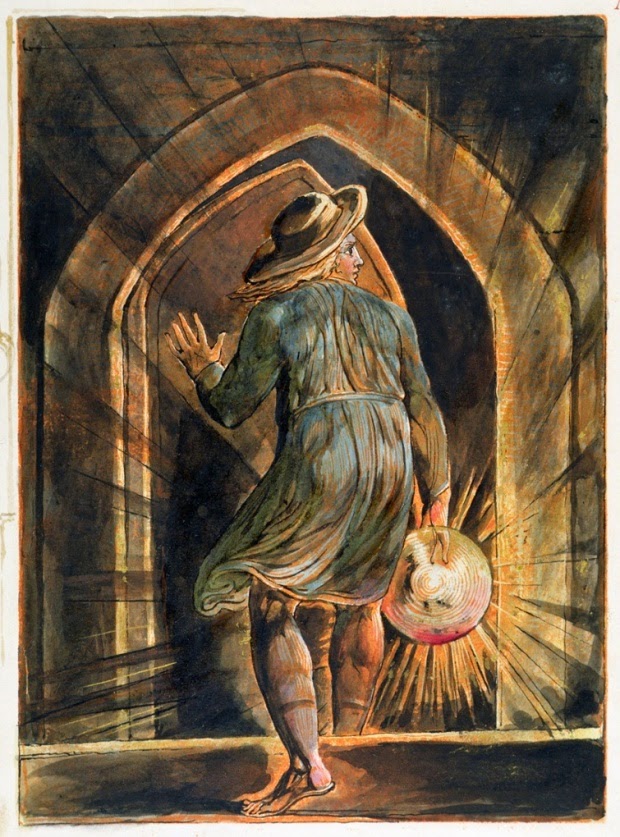
I have contributed a comment to the blog for the Inspired by Blake* festival in Oxford, which begins on 18 January. This follows a post for A New Map of Wonders last month.
Something that was new to me: early in his career Blake produced engravings for a report documenting the treatment of rebel slaves in Suriname.
* not this one

Image: via Guardian
Monday, December 29, 2014
Best of the year

My recommendations for this year include:
Listen: an interview about Syria with the surgeon David Nott and many episodes of Radiolab but e.g. Translation.
Reportage/Analysis/Opinion: James Fallows on The Tragedy of the American Military, James Meek's Worse than a Defeat on the British Army in Afghanistan, A Vision for Nature by George Monbiot and ‘Islamic State’ – Seven Impressions Of A Difficult Journey by Jürgen Todenhöfer
Fiction: Tenth of December by George Saunders (2013), Orfeo by Richard Powers (2014) and The Baron in the Trees by Italo Calvino (1959). I've had a copy of the last of these three on my shelf since 1986 and only got around to reading it this month.
Non-fiction: The Copernicus Complex by Caleb Scharf (2014), Indonesia etc by Elizabeth Pisani (2014), Adapt by Tim Harford (2011) and Landmarks by Robert Macfarlane (forthcoming in 2015).
Watch: Twelve Years a Slave (released in 2013), Grand Hotel Budapest, Two Days and a Night.and more...
The least boring post on this blog this year may be A Cabinet of Curiosities for the Anthropocene.
My book recommendations for 2013 are here.
Image from story by Martin Chulov about Umm Abdu, a medic in Aleppo
Sunday, November 09, 2014
Protect the Hen Harrier

I have a review of Ten Million Aliens by Simon Barnes in the Telegraph. The following passage was cut in the edit:
...The point is no less true for being a bit of a cliche. Indeed, if some accounts are to be believed, standing up for the truth of it may have may have cost Simon Barnes his lucrative and enjoyable career as Chief Sports Writer at The Times, from which he was dismissed in June of this year. According to some accounts, Barnes spoke up one time too many against the illegal killing in England of Hen harriers, a spectacular and beautiful raptor that is all but extinct in that country. As Barnes notes in the book, “only one pair of hen harriers succeeded in breeding in 2012...Simon Barnes's blog is here. In a recent post he says:
I am out there cheering for all the real conservationists... They are the people who are constantly seen as sentimentalists trying to save nice fluffy animals when in fact, as the great Gerald Durrell said, what we’re actually trying to do is stop the human race committing suicide.The RSPB Hen Harrier Appeal is here
Image: Wild Scotland
Tuesday, October 28, 2014
Suburbs
We live in these places out of necessity, lucky to have them out of the terrible explosion of humanity. But we visit and remember lakes, forests, architecture, cities of wonder, unruly temples, oceans, islands, the ecstasy of nature. We remember nature intimately and forcefully, and we recall lovely or powerful cities with delight at their art. That is why they become the focus of meaning in the afterlife. That is why they are wholly remembered.-- Louise Erdrich
Friday, October 17, 2014
Alarms and surprises

Paul Kingsnorth's LRB review of This Changes Everything by Naomi Klein and Don't Even Think About It by George Marshall is worth a read. For example, Klein's determination to make climate change fit into her pre-existing narrative [1] is well highlighted.
But I take issue with the end of the review, which quotes something Daniel Kahneman said to George Marshall — "there is not much hope" — and appears to take this as conclusive.
I think this falls into the trap of another pre-scripted narrative — that of radical pessimism.
Not only do we not know how things will go; we cannot know how things will go.
What we do know is that we have some freedom of action, albeit with tight constraints.
Sure, the future is likely to be hot, extremely bumpy and crowded, but we should not discount surprise altogether, not least significant technological and/or social changes which reshape the landscape of possibilities.
We should not assume, as Kahneman appears to do here, that climate change can only be tackled by lowering people's standard of living. Indeed, the opposite may be true.
"Anything can happen in life, especially nothing" says Michel Houellebecq. He is right on the first point, not so much on the second.
Note [1]: On narratives, see Culture and Climate Change: Narratives edited by Joe Smith, Renata Tyszczuk and Robert Butler (pdf) for which I organised 11 responses by others to the question, "What kind of story is climate change?" and in which I discussed four stories in the "In Conversation" section (also published here).
Friday, September 05, 2014
"Life is something that happens on the edge"

This post contains some additional notes and comments to my review of The Copernicus Complex by Caleb Scharf, which is published here.
I suggested the Telegraph use this photograph with the review because it's striking, of course, but also because the archaea growing in the Silex Spring live at the edge. For significance of that, see below.
Here is an attempt at humour that, wisely, did not make the final edit:
One of my favourite books is The Pooh Perplex. One of my least favourite viruses is Herpes Simplex. So I was intrigued when I first heard the title of this book. What on Earth (or beyond it), I wondered, could be The Copernicus Complex?Copernicus...was wrong. Among the things that he (and indeed Kepler and Newton) did not know is that, far from being fixed, the Sun itself is moving through space at about 200 kilometres per second, completing a rotation of the galactic centre once every 240 million years or so.
... small differences...can turn out to make all the difference. Before the edit the second paragraph continued:
Nature is subtle and “little” things can be clues to much bigger mysteries. And in time even the Kepler's laws of planetary motion (and the laws of motion and gravitation which Isaac Newton developed towards the end of the same century) have proven to be only approximations. An anomaly in the orbit of Mercury supported Einstein's general theory of relativity (1916), which challenged basic assumptions in all physics to date. Further, in the last couple of decades unprecedented computing power has enabled researchers to show that even apparently well-established elliptical paths can actually be far from fixed. In the long run seemingly small perturbations can, and often do, cause planets to careen off course into their host stars or each other or go whizzing off into deep space.Copernican principle... Anthropic principle... Contrasting takes appear in This Will Make You Smarter. P Z Myers recommends the mediocrity principle, and Samel Abbessman the Copnerican principle. But Marcelo Gleiser thinks we are unique. On the 'special' side, Alan Lightman observes:
With the recent work of the Kepler spacecraft, searching for planets favorable for life, we can estimate that only about one millionth of one billionth of 1 percent of the material of the visible universe exists in living form. From a cosmic perspective, we and all life are the exception to the rule.and Jim Holt argues that:
living in a generic reality that's mediocre, there are nasty bits and nice bits and we could make the nice bits bigger and the nasty bits smaller and that gives us a kind of purpose in life.
Much to enjoy on the way including things like this. Scharf notes the language of orbital dynamics:
Resonances, precessions, librations, osculating elements, apsidal alignments, arguments of pericenter, harmonics, secular perturbations and always the mention of chaos.I really did enjoy this book but there were moments when I felt it could be shorter with no loss of quality. For example, do we really need another explanation of Bayes's theorem just to be told that it is ill-advised to draw conclusions when you have a sample size of one? Perhaps I have just read too much popular science.
Earthlike planets in the Goldilocks zone...are a small minority ...albeit a minority that contains billions!
the cosmo-chaotic principle this idea is the heart of the book, and I would have liked to have got there sooner and read more about it including, for example, an expansion of this:
Several people who are studying the biological universe have suggested we adopt this way of conceptualizing life, as a phenomenon hovering on the bring of disorder. Michael Storrie-Lombardi – life is something that happens on the edge, wherever that edge appears...life is a collection of phenomena at the boundary between order and chaos. Across that interface we can imagine there is something akin to a voltage difference. Except this biological gradient is multidimensional, an intersection of available energy, order and disorder, and time.But perhaps that's the next book or paper...
Among books I recommend for further reading are Five Billion Years of Solitude by Lee Billings, The Edge of Infinity by David Deutsch and Weird Life by David Toomey.
Image: A wandering stone in Death Valley. Dennis Flaherty/Alamy via Nature. Stones like this move about for about one minute in every million.
Thursday, July 17, 2014
Superintelligence

I have a review in The Guardian of Superintelligence by Nick Bostrom and A Rough Ride to the Future by James Lovelock. I wasn't sure it would work to pair these books, but it seems to have turned out OK as far as it goes. Here are a few additional comments and notes.
An interesting piece on Roko's Basilisk. "The combination of messianic ambitions, being convinced of your own infallibility, and a lot of cash never works out well."
Bostrom recently outlined his ideas at the RSA. You can listen to the recording here.
Once we begin to celebrate... this phrase is from Thomas Berry's essay The Ecozoic Era. In the western mystical tradition see also, inter alia, Thomas Traherne. A state of awareness that unites elevated cognition and affect might enable what the writer Tim Robinson calls the good step -- though he doubts this is durably achievable for humans: “Can such contradictions be forged into a state of consciousness even fleetingly worthy of its ground?”
An interesting piece on Roko's Basilisk. "The combination of messianic ambitions, being convinced of your own infallibility, and a lot of cash never works out well."
Bostrom recently outlined his ideas at the RSA. You can listen to the recording here.
Once we begin to celebrate... this phrase is from Thomas Berry's essay The Ecozoic Era. In the western mystical tradition see also, inter alia, Thomas Traherne. A state of awareness that unites elevated cognition and affect might enable what the writer Tim Robinson calls the good step -- though he doubts this is durably achievable for humans: “Can such contradictions be forged into a state of consciousness even fleetingly worthy of its ground?”
New machines could one day
have almost unlimited impact on humanity and the rest of life See Turing's Cathedral: the Origins of the Digital Universe by George Dyson (2012).
killing remotely - already, notes The Economist, America is arguing about whether to give medals to pilotless drones.
singularity... by around
2030 [discredited] See, for example the resounding meh from Bruce Sterling and this by Alan Winfield. Some analysis suggests consciousness may be intractable to mathematics and the forms of intelligence we identify as most well developed in
human societies appear to be dependent on consciousness.
The argument that a superintelligent system will
shape the world according to its “preferences” preferences is developed in chapters 5 and 6 of Bostrom's book. The argument that most preferences that such an agent could have will...involve the
complete destruction of human life and most plausible human values is developed in chapters 7 and 8.
balance of risks here are the five biggest risks to humanity according to Sandberg et al.
balance of risks here are the five biggest risks to humanity according to Sandberg et al.
Lovelock thinks...in the very long term...we should welcome-machine-based consciousness. Sara Imari Walker and Paul Davies speculate that “life forms that ‘go digital’ may be the only systems that survive in the long run and are thus the only remaining product of the processes that led to life.”
For a far out scenario for life in the very very very long term see this.
[superintelligence] will
live and experience thousands of times as fast as we
can - here is more from Turing's Cathedral (page 302)
...Organisms that evolve in a digital universe are going to be very different from us. To us, they will appear to be evolving ever faster, but to them, our evolution will appear to have been decelerating at their moment of creation – the way our universe appears to have suddenly begun to cool after the big bang. Ulam's speculations were correct. Our time is become the prototime for something else.catastrophic risk see It could be worse and this profile by Ross Andersen.
judgement on right or wrong. Bostrom writes at the beginning of Superintelligence that it is likely that his book is seriously wrong and
misleading. He adds, however, that alternative views, including the
idea that we can safely ignore the prospect of superintelligence, are
more wrong.
There may (or may not) be mileage in thinking about and comparing to scenarios in which superintelligence arrives from outer space. Stephen Hawking is among those who suggest this would
probably be a catastrophe for humanity, analagous to the slaughter of indigenous Americans by Europeans. In The Beginning of Infinity (Chapter 9) David Deutsch counters that any
civilisation sufficiently advanced to transport itself across
interstellar distances would, necessarily, have no need of the raw
materials, or anything else, in our solar system. Deutsch continues:
“Would we seem like insects to [an advanced alien civilisation]?
This can seem plausible only if one forgets that there can only be
one type of person: universal explainers and constructors. The idea
that there could be beings that are to us as we are to animals is a
belief in the supernatural.”
stupidity The first story in Stanislaw Lem's Cyberiad is about a machine which its inventor intends to be fantastically intelligent but which turns out to be incorrigibly stupid. And, of course, in Douglas Adams's Hitchhiker's Guide to the Galaxy, Deep Thought calculates that the answer to the ultimate question of life, the universe and everything is 42. When the receivers of the Ultimate Answer demur, Deep Thought replies that "[he] checked it very thoroughly, and that quite definitely it is the answer. I think the problem, to be quite honest with you is that you've never actually known what the question was."
stupidity The first story in Stanislaw Lem's Cyberiad is about a machine which its inventor intends to be fantastically intelligent but which turns out to be incorrigibly stupid. And, of course, in Douglas Adams's Hitchhiker's Guide to the Galaxy, Deep Thought calculates that the answer to the ultimate question of life, the universe and everything is 42. When the receivers of the Ultimate Answer demur, Deep Thought replies that "[he] checked it very thoroughly, and that quite definitely it is the answer. I think the problem, to be quite honest with you is that you've never actually known what the question was."
Image: natural stone arch near Þingvellir in Iceland, site of an early Parliament. Jacob Bronowski warned "we must not perish by the distance between people and government, between people and power."
Tuesday, May 13, 2014
A distant roar
...At first there weren't any rivers either, the waters ran deep under the ground. All you could hear of them was a distant roar, like that of powerful rapids. They formed a great waterway the shamans called Moto uri u. One day Omama was working in his garden with his son when the boy started to cry because he was thirsty. To quench his son's thirst, Omama made a hole in the ground with a metal bar. When he pulled it out, water leaped up to the sky. It pushed back his child, who had come to drink his fill, and shot all the fish, skates and caimans into the sky. The stream rose so high that another river formed on the sky's back, where the ghosts of our dead live. Then the waters accumulated on the earth and ran off in every direction to form the rivers, streams and lakes of the forest...from The Falling Sky: Wordsof a Yanomami Shaman by Davi Kopenawa and Bruce Albert
Tuesday, May 06, 2014
A Cabinet of Curiosities for the Anthropocene

On 4 May I presented a small Cabinet of Curiosities for the Anthropocene at the First Athens Science Festival. The event was filmed. Here is a list of the objects that made the cut:
1. Nautilus shell -- a beautiful form embodying lessons of time, structure and number from hundreds of millions of years of prehuman history.As I said, this was a first cut. I hope to increase/improve the representation of objects in the Cabinet over time. If you have a suggestion please tweet with the tag #AnthropoceneCuriosity
2. Woomera -- an Aboriginal Australian spear thrower. The ever improving capability to hurl deadly project projectiles over long distances has been a key factor in human culture.
3. Flute made from a seed -- Amazonian, perhaps Marajoara or Tapajonica. Creating music in harmony with one's environment has also been a vital strand across many cultures and times.
4. Sculptures from the Hamangia Culture, circa 5000 to 4600 BC (photograph). Settled societies with increasingly well developed agriculture supported new cultural forms.
5. Sickle -- one of the oldest and most important agricultural tools. Agricultural societies gave rise to tax systems.
6. Medieval bestiary (facsimile), England, circa 1300. Knowledge and belief systems change over time. Scientific endeavour cannot be divorced from value.
7. Smallpox virus -- fate of densely settled communities is hugely influenced by pathogens such as this. The elimination of smallpox a major triumph of medical science.
8. Sugar -- central to a early phase of globalisation, first time large amounts of energy transported from one part of the world to another.
9. Stirling engine (1816). The atmospheric engine developed by the blacksmith Thomas Newcomen (1712) started the "Anthropocene proper." Stirling engine, more efficient, may be part of better way forward.
10. Plant fertilizer. The Haber-Bosch process (1913) facilitated massive growth in agricultural productivity and enables a population of more than 7 billion, for now.
11. International peacekeeper (toy). Increasingly globalized economy is vulnerable to instabilities. Climate change likely to be one among several factors behind some conflicts.
12. What is Life? by Erwin Schrödinger (1944). "Living things embody process far more intricate than atoms or stars." What is our biotech/synbio future?
13. Odroid -- a "supercomputer" in a 8cm cube. Each of its four CPUs can perform more than 2 billion operations per second. It costs less than 50 Euros.
14. Superintelligence: Paths, Dangers, Strategies by Nick Bostrom (2014). Superhuman machine intelligence could be "the best or the worst thing that has ever happened to humanity."
15. Cone shell -- our future is hugely influenced by the fate of the oceans.
16. Nurdles -- the oceans are increasingly filled with tiny plastic particles.
17. Black rhino sculpture, carved from ivory of illegally poached elephant, Zambia, 1980s. We are going through a mass extinction event.
18. Bird Bingo -- what perishes and what thrives in the Anthropocene is uncertain. Robins and other birds appear to be adapting to ionizing radiation around Chernobyl.
19. Air freshener -- what kind of world do we fool ourselves we are living in?
Thanks to Stephen Hicks, Mike Mason, Matt Prescott, Callum Roberts and Veronica Strang for the loan of objects.
Thanks to Richard Ashcroft, Tom Clarke, Gavin Francis, Tim Harford, Christiana Kazakou, Paul Kingsnorth, Robert Macfarlane, Oliver Morton, Xenophon Moussas, Andrew Simms, Joe Smith, Marina Warner and others for their thoughts.
Image: Hephaestos, the blacksmith god.
Monday, March 31, 2014
"A sense of immanent meaning or significance"

I spent a good part of a day in February with Richard Mabey, and wrote a piece for The Telegraph, which was just published (see note). Here's a passage from Mabey's biography of Flora Thompson that I particularly liked:
The naturalist William Hudson wrote an essay in 1918 about what he called the animism of children. "By animism I do not mean the theory of a soul in nature," he explained, "but the tendency or impulse or instinct, in which all myth originates to animate all things; the projection of ourselves into nature; the sense and apprehension of an intelligence like our own but more powerful in all visible things. It persists and lives in many of us, I imagine, more than we think, or more than we know, especially those born and bred amid rural surroundings...
Hudson reckons he was about eight years old (much the same age as Flora at her most sensually alert) when the raw intensity of his registration of colour, scent and sound -- "the sparkle of sunlight on water, the taste of milk, of fruit, of honey, the smell of dry or moist soil, or herbs and flowers; the mere feel of a blade of grass" -- began to take on a sense of immanent meaning or significance, as if these objects and phenomena contained some impalpable essence beyond their physical reality. They become talismans and totems, sometimes even slightly magical.
Note: The Telegraph version omitted the passages in black below:
Mabey, 73, is in vigorous form for a man recently laid low by a virus that was leaving him quickly fatigued, and loving life in Norfolk. He moved here around a dozen years ago after spending most of his life in the Chilterns, and after an episode of a severe depression which he documents the highly acclaimed memoir Nature Cure (2005). The day before I visit he has been up on the great beaches of the North Norfolk coast. It's a vast place that is always changing, he says, and one he has visited many times over the years since student days. Yesterday birds that are usually there at this time of year were, he says, strangely absent. The Brecks (East Anglia's heathland) and the Broads (its magical waterland) are also a short drive away and frequent destinations...
But the non-human world, so far away from the political nightmares of that time, was never far away for Mabey. While working as an editor at Penguin, he wrote Food for Free (1972), a guide for foragers of wild berries, fungi and shoreline delights. The book was an immediate success and has never been out of print. “It is my pension fund,” he says with a smile, adding that foraging is not the sole preserve of hippies. During the Second War, the government issued an advisory pamphlet while the Vicomte de Maudit stirred phlegmatic British hearts and stomachs with They Can't Ration These!
Mabey's second book, The Unofficial Countryside, helped to define a new, edgier kind of nature writing. Inspired by Adventure Lit Their Star, Kenneth Alsop's 1949 account of how the little ringed plover established itself “in the messy limbo which is neither town nor country (...sand pits, quarries, reservoirs, sewage farms...on clinker among junked car bodies as well as natural river shingle),” The Unofficial Countryside was republished in 2010 with an introduction by Iain Sinclair, doyenne of British psychogeographers, and is an important text for anyone thinking about the “rambunctious garden” or feral future of non-human life under enormous pressure from humanity...
Tuesday, March 04, 2014
The unanswerable question

The apparent confusion between the reality of dreams and the reality of waking life... allows writers to use dreams to question reality without having to attempt an impossible imitation of a dreamlike state. In one of his unpublished notebooks, Coleridge famously wrote:
If a man could pass through Paradise in a dream, and have a flower presented to him as a pledge that his soul had really been there, and if he found that flower in his hand when he awake—Aye! and what then?
So unanswerable is the question, so neatly does it blend the reality of dreams and the reality of waking life, that H. G. Wells, in order to lend verisimilitude to the nightmarish fantasy of The Time Machine, borrowed Coleridge’s unsettling supposition and concluded his story with just such a flower.-- Alberto Manguel
Monday, February 17, 2014
SF & AI
At a talk at the Oxford Martin School titled Artificial intelligence: examining the interface between brain and machine, I asked Anders Sandberg what role, if any, cultural products, including fiction, could usefully play in thinking about the future.* He replied:
Here is an article titled The Dawn of Artificial Intelligence.
At Charlie Stross's blog, Ramez Naam argues that The Singularity is Further Than It Appears.

* The video is here. My question is at 1.05.30 and Sandberg's reply at 1.09.15. I mentioned Marvin the Paranoid Android in the preface to my question in reference to his anecdote, at 1.01.00, about a robot he built that got stuck in a pattern of learned helplessness. The transcript above is not exact.
P.S. Maria Popova suggests some reasons why science fiction writers are good at predicting the future.
I quite like Asimov's robot stories because they are beautiful demonstrations that if you try to get your robots to behave according to a fixed set of rules there are going to be conditions that lead to bizarre or stupid behaviours. There are actually good demonstration of why you shouldn't use that sort of programming. But Asimov came up with the rules mostly to have a good framework for this stories. The real problem is when people think they are proposed seriously.I think the money quote in this talk was "We have very little idea how to encode a good values system [into intelligent machines]."
Any individual story, and individual piece of fiction is not going to work. But I think reading a lot of science fiction is actually quite useful to stretch your mind. None of the individual stories in necessarily useful or helpful but they can help you get into mindsets that are very different. If there is one thing science fiction is about it is about dealing with the other – dealing with very different situations and especially beings that function in a very different way. And I think that flexibility is important when we start to reason about it. Ray Kurzweil suggested that we give future AI the golden rule. That way they would learn how to behave themselves. But anyone who has tried to explain the golden rule to an inquisitive 8 year old will realise there are plenty of loopholes in that. And that's a human 8 year old. If this had been an AI 8 year old the loopholes that are obvious to an intelligent machine would be very weird to us.
Here is an article titled The Dawn of Artificial Intelligence.
At Charlie Stross's blog, Ramez Naam argues that The Singularity is Further Than It Appears.
* The video is here. My question is at 1.05.30 and Sandberg's reply at 1.09.15. I mentioned Marvin the Paranoid Android in the preface to my question in reference to his anecdote, at 1.01.00, about a robot he built that got stuck in a pattern of learned helplessness. The transcript above is not exact.
P.S. Maria Popova suggests some reasons why science fiction writers are good at predicting the future.
Thursday, February 13, 2014
The stars move still, time runs, the clock will strike

The hypothesis that the Chicxulub asteroid struck in June or July was mentioned by Jay Melosh on Radiolab's Apocalyptical, December 2013
Total content of the world’s nuclear arsenals According to nucleardarkness.org in 2009 there were 23,335 weapons with total yield 6,400MT (pdf).
Permian... a few decades see analysis by Paul Wignall (video) -- initial pulses of CO2 over tens and hundreds to thousands of years, perhaps triggering a rapid release of methane over a few decades
30 to 50% of species functionally extinct by 2050 Sourced here
Additional input of heat...equivalent to...four atomic bomb detonations per second See here. As I noted in Minotaur, the additional accumulation of heat in the oceans since the 1870s due to human activity is estimated as equivalent to 10 billion Hiroshima bombs.
exact and beautiful adaptations Jacob Bronowski's lovely phrase occurs in the first few pages of The Ascent of Man (1973), about which Simon Critchley recently wrote a rather good piece.

artists an interview with Maya Lin at Yale360. Tove Jannson had other disasters on her mind in 1946 but this still resonates.
extinctions... see these posts on extinction in The Blog of Barely Imagined Beings
... and new discoveries not just of species, many of which are verging on extinction even as they are discovered (or rediscovered) but also processes in the Earth system itself of which we previously had little or no idea. So, for example, scientists did not anticipate the ozone hole (as is nicely summarised in this piece by Alice Bell). In the event, the international community was able to largely solve this problem. The discovery of ocean acidification -- or at least the likely rapidity of its occurrence and the potential dangers it poses -- came as a surprise to many if not all. Unlike ozone depletion, ocean acidification does not appear to have easy answer. A significant future surprise -- an unknown unknown -- may be relatively easy to solve, as ozone depletion appears to have been, or be wickedly hard, as ocean acidification appears to be.
Amphibians a spark for Kolbert's book was her article about disappearing frogs in The New Yorker in 2009.
It's all pretty grim... The Guardian cut the rest of the sentence:
...but reading The Sixth Extinction is like riding in a well-engineered German car. With apologies to Edward Behr, it could be titled Anything Here Nearly Extinct and Have a Scientist with First Class Communication Skills as a Spokesperson?spend... hundreds of millions of dollars to keep the majority in the dark See, e.g.,
Conservative groups spend up to $1bn a year to fight action on climate change and In the Carbon Wars, Big Oil Is Winning
it almost repels thought in a review, Kathryn Schulz writes:
It could be that dwelling in geologic time, as you must do to write about extinction, is good for perspective but bad for action; the arc of the actual universe is so long it bends toward fatalism. Human time, by contrast, is good for acting but bad for seeing. It is into the chasm between these two timescales that species are dropping like flies.hyperobject - an accessible introduction
_cropped.jpg)
imaginative thinking Lee Billings (whose recent book I reviewed here) writes:
The great difficulty in all of this is that no one yet knows how the Anthropocene will unfold. Our dominion over the planet may prove brief in the scope of deep time. Or, the Anthropocene could transform the entire planet into some new state that persists for the remainder of the Earth’s existence. Most wildly, the Anthropocene might surpass the boundaries of Earth itself, becoming interplanetary if our descendants extend our geological footprints to other worlds. Knowing that we have our own age to shape may alter what we do with it, with possible outcomes lying somewhere between our immortal reign and imminent demise.But a distinct possibility is a “gone-away world [rather] than birth of anything new...Radioactive fallout as fingerprint”
We need new big stories I had a sentence before this:
We have long since left behind the “places of many generations” known to our palaeolithic ancestors. We need new big stories.J L Schellenberg asks Why are our imagined futures so shallow?
what comes next Chris Thomas is optimistic:
We worry about extinction of species in the era of humans. But at the same time we are seeing an evolutionary surge. The seeds of recovery are already visible.See also Henry Nichols on rats as big as sheep and Robert Krulwich on pregnant brains
a world utterly transformed by synthetic biology one place to start thinking about that is here
Is it too much to ask... I made an assertion here not a question: “It is not absurd to ask...” ...whether we can express our humanity...with compassion... These words are from the palaeoanthropologist Rick Potts as quoted by Lee Billings (see link above).
George Szirtes recently tweeted
It is salutary to remember that we are walking on egg shells from first day to last and that we're not weightless. We walk between storms.
Images: Priceless or Worthless? (pdf); Manāfi˓-i al-ḥayavā, or The Benefits of Animals (1297-1300) by Ibn Bakhtīshū (via Persian Painting); and Goya's El Gigante o El Coloso (1814-1818)
Subscribe to:
Posts (Atom)